
I. Introduction
Laser cutting technology is a critical enabler for lean production and flexible manufacturing, holding an irreplaceable position in enhancing component precision and optimizing production rhythms. Consequently, the decision to purchase a high-performance laser cutting machine now goes beyond simply selecting technical specifications—it has evolved into a comprehensive process that encompasses technical criteria, supply chain management, and financial planning.
This guide aims to provide you with a clear framework for making informed procurement decisions. We will thoroughly examine the leading purchasing methods available in today’s market, including the in-depth technical collaboration offered by direct manufacturers, the personalized local services of authorized distributors, the resource integration advantages of online platforms, and the cost-saving opportunities presented by the second-hand market. From tracing equipment quality and warranty execution to after-sales technical support and total lifecycle costs, we will systematically compare the core differences across these procurement channels.
Our ultimate goal is to help you establish a rigorous and scientific procurement evaluation system, effectively mitigating contractual risks and service deficiencies, and ensuring your investment is transformed into high-reliability, high-efficiency fixed assets with enduring value.
II. Understanding Laser Cutting Machines
1. Types of Laser Cutting Machines
(1) Classification by Laser Type
| Type | Applicable Materials | Features |
|---|---|---|
| CO₂ Laser Cutting Machine | Non-metals (wood, acrylic, leather, fabric), some metals (requires high power) | Good beam quality, excellent non-metal cutting effect; higher maintenance costs |
| Fiber Laser Cutting Machine | Metals (steel, aluminum, copper, alloy), some engineering plastics | High photoelectric conversion rate (>30%); simple maintenance, low energy consumption; significant advantages in metal cutting speed |
| YAG Laser Cutting Machine | Thin metals, special materials | Gradually being replaced by fiber; suitable for highly reflective metals (such as copper) |
(2) Classification by Structure
- Gantry Type: Large-scale industrial equipment (working area above 3m × 1.5m), offering high precision and speed, ideal for mass production.
- Desktop Type: Compact machines (working area less than 1m²), suitable for small-batch processing.
- Portable Type: Handheld all-in-one laser welding/cutting machines, flexible but with lower power output (typically less than 1000W).

2. Key Specifications and Parameters
(1) Laser Source Type
Before purchasing, users should clearly define the materials they intend to cut:
CO2 lasers are suitable for non-metal materials and some metals.
Fiber lasers are ideal for a wide range of metals, offering high efficiency, low energy consumption, and minimal maintenance costs.
YAG lasers are best used in applications requiring extremely high precision.
(2) Laser Power
Laser power is the primary indicator of a laser cutting machine’s processing capability, directly affecting the types of materials it can handle, the maximum thickness, and the cutting speed.
Generally, higher laser power allows for faster cutting speeds and the ability to cut thicker materials of the same type.

(3) Worktable Size
The size of the worktable is crucial in determining whether the machine can accommodate the required materials. For large-scale cutting, select a worktable that matches the material size.
Laser cutting machines are often designated by numerical codes, with popular models including:
- Model 3015: Effective working area of 3000mm (length) × 1500mm (width), commonly used for sheet metal fabrication.
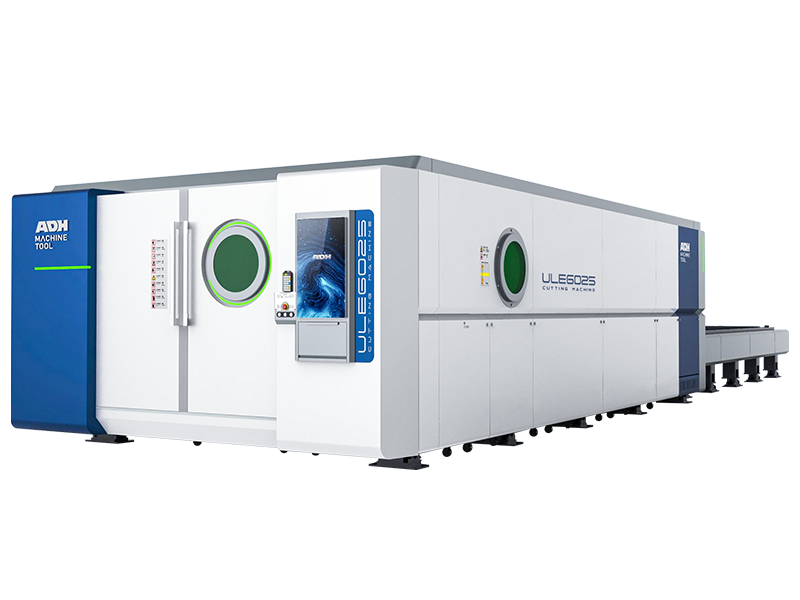
- Model 6025: Effective area of 6000mm × 2500mm, suitable for larger sheets or nesting more parts in one run.
- Other common models: such as 4020 (4000mm × 2000mm), 6020 (6000mm × 2000mm), and more.
(4) Cutting Precision and Speed
Cutting precision and speed are vital metrics for assessing a laser cutting machine’s performance.
High-precision machines can deliver cuts accurate to the millimeter, while high-speed models boost production efficiency.
Laser power and speed are interrelated and can be estimated using the following formula:
P = K × T × V
(P: Power in watts, T: Thickness in millimeters, V: Speed in meters per minute, K: Material coefficient; Steel = 80, Aluminum = 120).
For example, when cutting steel:
Parameter T = 10mm, V = 2m/min, K = 80
Calculation: P = 80 × 10 × 2 = 1600W
This empirical formula gives an estimated power requirement; for precise values, consult your supplier or refer to our Brochures.

(5) Degree of Automation
| Automation Level | Main Features and Functions | Typical Application Scenarios |
|---|---|---|
| Manual Operation | All loading/unloading, parameter adjustment, and monitoring require manual completion. | Small batches, trial production |
| Semi-automation | Possesses some automation functions, such as automatic loading/unloading, automatic edge finding, and automatic focusing, but some processes still require manual intervention. | Small to medium batch production |
| Full Automation | The entire process of loading, cutting, unloading, waste separation, parameter adjustment, and monitoring is automated. It can be linked with MES/ERP systems to achieve unmanned production. | Large batches, smart factories |
| Flexible Automation/Intelligent Automation | Integrates AI algorithms, visual recognition, remote monitoring, adaptive process optimization, online quality inspection, etc., and has high flexibility and self-learning capabilities. | Multi-variety customization |
When selecting a laser cutting machine, base the level of automation on your actual needs and budget.
For businesses aiming to boost productivity, minimize manual intervention, and enhance product quality, high-end machines with advanced automation—such as auto loading/unloading, auto-focusing, and automatic adjustment—are recommended.
However, if budget constraints are a concern, machines with lower automation may be considered, but keep in mind the potential trade-offs in efficiency and quality.
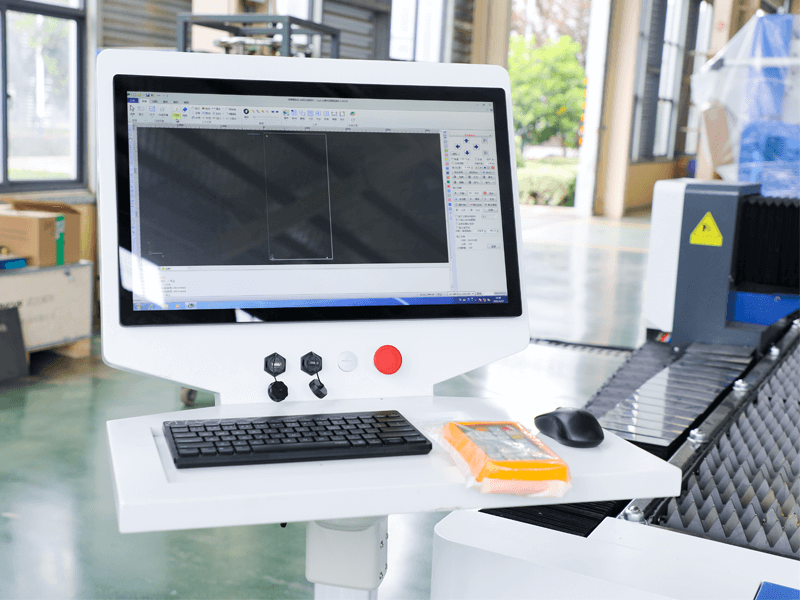
For further guidance on choosing the right laser cutting machine, refer to our detailed explanation in What Laser Cutting Machine to Buy.
Ⅲ. Reliable Channels for Purchasing Laser Cutting Machines
1. Direct Purchase from Manufacturers
Buying directly from the laser cutting machine manufacturer eliminates all intermediaries, creating the most direct connection between the user and the technology provider.
(1) Advantages
1)Ensures the equipment is genuine and comes with clear and transparent specifications.
2)Pricing is open and straightforward, removing the profit margins of middlemen.
3)Manufacturers can often provide customized solutions based on customer needs, ensuring both quality and delivery timelines.
4)Customers benefit from comprehensive technical support and after-sales service.
(2) Disadvantages
1)Direct sales from manufacturers typically offer less room for negotiation, making it difficult to secure significant discounts.
2)The process usually requires formal business procedures, such as contract signing, custom manufacturing, and logistics arrangements, resulting in a longer overall cycle and less flexibility.

This option is best suited for enterprise users who place a high priority on equipment performance, service, and long-term partnerships, and who require a standardized procurement process. If you are looking for a reliable manufacturing partner, consider contacting ADH Machine Tool.
2. Authorized Agents/Dealers
These companies are officially authorized by laser cutting machine manufacturers to sell products and provide after-sales services within specific regions.
(1) Advantages
1)Ability to view and test the equipment on-site, along with receiving localized service and technical support.
2)Large agents often represent multiple complementary brands, offering a wider range of options and comparisons.
3)More flexible payment methods and financing options (such as leasing or installments) compared to direct manufacturer sales.
(2) Disadvantages
1)Prices are generally slightly higher than direct purchases from manufacturers, as they include the dealer’s service and profit margins.
2)Service quality and responsiveness can vary between agents, so it’s important to review client feedback and industry reputation when making a selection.

This channel is ideal for those who value localized service and quick response, wish to compare different brands, seek flexible business solutions, or are located where direct manufacturer sales are unavailable.
3. Specialized E-commerce Platforms
For buyers who prioritize a curated experience—especially professionals, small businesses, or passionate enthusiasts—specialized e-commerce platforms offer distinct advantages over general marketplaces. Focusing exclusively on digital manufacturing tools, these platforms leverage deep industry expertise and community trust to build unique business models.
(1) Leading Platforms
Notable names in this category include MatterHackers, Madethebest, and Gearberry.
MatterHackers has established a strong community in the 3D printing sector and has since expanded its offerings to include laser cutters.
Madethebest and Gearberry, on the other hand, concentrate on selecting and promoting innovative products from emerging brands, allowing buyers to access cutting-edge technologies as soon as they become available.
(2) Core Values and Strengths
The main value of these platforms lies in reducing the buyer’s research burden and minimizing post-purchase hassles. Their product and service advantages are reflected in:
1) Comparison Tools: These platforms typically provide convenient tools for comparing key parameters—such as laser power, work area, software compatibility, and maximum cutting thickness—across different models, greatly streamlining the decision-making process.
2) Authentic User Reviews: By fostering active user communities, these platforms offer buyers access to detailed reviews, project photos, and firsthand feedback. Genuine experiences from fellow users often provide more practical insight than official marketing, helping buyers better understand real-world performance and potential issues.
3) One-stop Shop for Consumables and Accessories: Another major benefit is easy access to a complete product ecosystem. Buyers can conveniently purchase compatible materials (like certified plywood or acrylic sheets), replacement parts (such as lenses, mirrors, or laser tubes), and essential accessories, ensuring long-term, efficient operation of their equipment.
4. Large Comprehensive Online Marketplaces
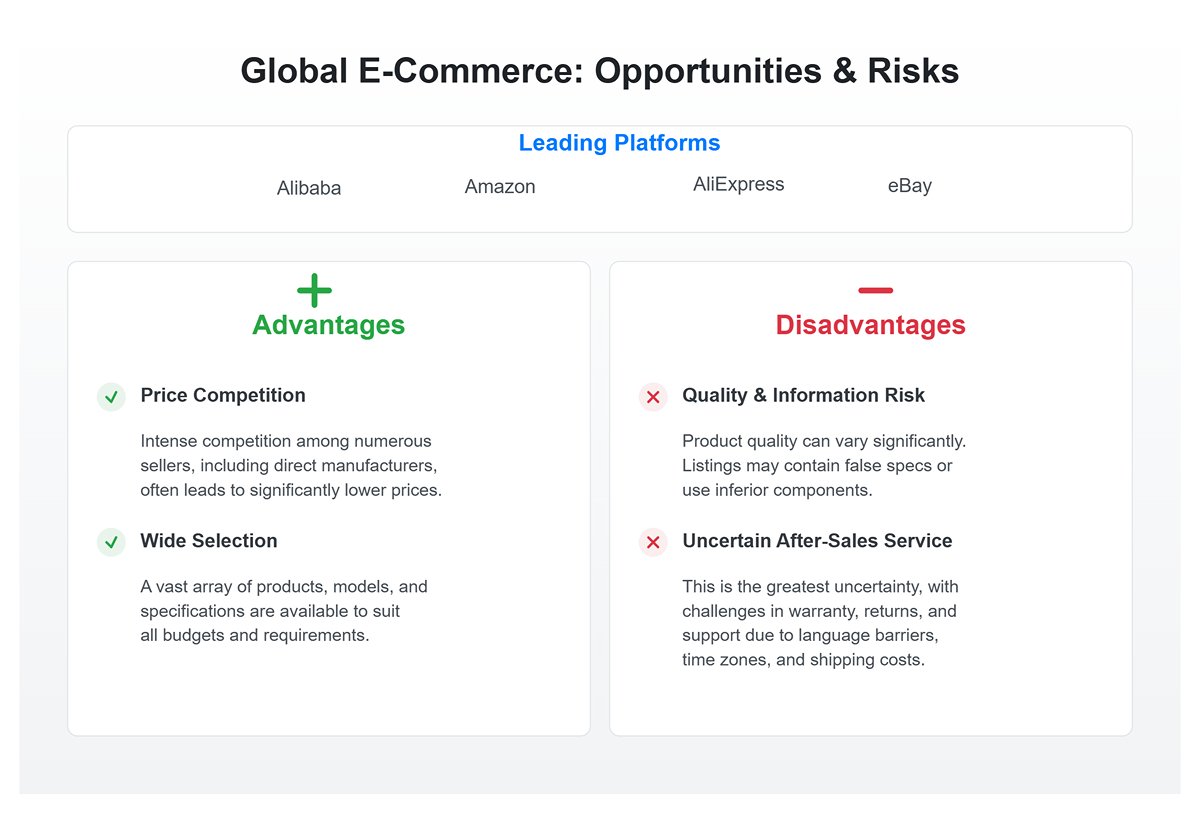
(1) Leading Platforms
This category is dominated by global giants such as Alibaba (primarily B2B), Amazon, AliExpress (international B2C), and eBay.
(2) Pros and Cons
Shopping on these platforms brings both opportunities and risks.
1) Advantages: With numerous sellers, many of whom are direct manufacturers or primary distributors, there is intense price competition. Buyers often find products at lower prices than elsewhere, with a wide selection of models and specifications to suit all budgets and requirements.
2) Disadvantages: The vast scale and limited oversight introduce hidden risks. Product quality can vary significantly, and some listings may include false specifications or inferior components.
The greatest uncertainty often lies in after-sales service. Language barriers, time zone differences, and international shipping costs make warranty claims, technical support, and returns particularly challenging.
(3) Risk Mitigation Strategies
To shop safely on these platforms, buyers must be proactive and conduct thorough research. To protect your interests, consider the following:
1) Scrutinize Seller Credentials: Don’t just rely on the product page; dig into the seller’s track record, feedback rating, years in business, and transaction volume for high-value items.
2) Analyze User Reviews Critically: Don’t be swayed by average ratings alone. Focus on negative and neutral reviews, and watch for recurring issues such as “damaged on arrival,” “difficult software,” or “no after-sales support.” Be wary of generic, overly positive reviews; prioritize feedback with user photos or videos.
3) Request Proof of Credentials: For larger purchases, ask sellers for business licenses or factory inspection reports. If buying second-hand equipment, request proof of actual operating hours. Reputable sellers are usually willing to provide real product photos or live demonstration videos.
4) Leverage Platform Protections: Take full advantage of buyer protection services. On Alibaba, prioritize sellers with “Trade Assurance” and “Verified Supplier” badges.
On Amazon, choose items fulfilled by Amazon or marked as “Amazon’s Choice” for greater reliability and easier after-sales support—though this does not guarantee top-notch quality for every product.
Ⅵ. Supplier Assessment
1. Supplier Audit Checklist
Before making a purchase decision, it’s essential to thoroughly vet any retailer or distributor. Choosing a reputable supplier is your first line of defense against potential risks.
(1) Authorization and Legitimacy
The top priority is to verify whether the supplier is an officially authorized distributor for the chosen brand. Most manufacturers list their partners on their official websites. Buying from unauthorized sources may void your warranty, increase the risk of counterfeit or refurbished products, and forfeit access to official technical support.
(2) Reputation and Industry Standing
Research the supplier’s history and reputation in the industry. How long have they been in business? Do they specialize in laser systems or are they a general equipment supplier? Look for case studies, peer recommendations, and their presence at industry events. Experienced, specialized suppliers usually possess deeper product knowledge and a stronger commitment to the market.
(3) Independent Customer Reviews
Don’t rely solely on glowing testimonials featured on the supplier’s own site. Explore third-party platforms like Trustpilot, Google Reviews, and industry forums. While star ratings are useful, pay close attention to detailed comments about delivery speed, product condition on arrival, and responsiveness of after-sales support—especially how issues are handled.
2. Understanding Warranty Policies
A warranty is more than just paperwork—it’s a supplier’s promise. However, the specifics of these promises can vary widely.
(1) Coverage, Duration, and Details
Be sure to understand what is covered by the warranty and for how long. Pay particular attention to whether the entire machine is covered for a uniform period. Some core components often have separate, shorter warranties—a common industry practice. For example:
Frame/Base: 24-36 months
Laser Tube/Source: 6-12 months (typically considered consumables)
Optical Components (lenses, mirrors): 3-6 months, or sometimes excluded as consumables
Power Supply and Mainboard: 12-24 months
Clarifying these details in advance helps you avoid unexpected costs when replacing key parts.

(2) Exclusions and Fine Print
Watch out for warranty clauses that could invalidate your rights. Pay close attention to terms like “user damage,” “improper use,” or “failure to maintain,” as these can be subjective. Also, understand the logistics involved in warranty claims: Who pays for shipping replacement parts? Will the customer bear the cost? Knowing these details helps you assess the true value of the warranty.
3. Technical Training and Support
Even the most advanced equipment is useless without proper training and timely technical support.
(1) Training Programs
A quality supplier should provide comprehensive training—not just a user manual. Check whether their training covers:
1) Initial Setup and Safety: Unboxing guidance, device calibration, and safety protocols
2) Software and Operation: Full-spectrum training on mainstream control software (such as LightBurn, RDWorks), from basic to advanced features
3) Process Optimization: Adjusting parameters (power, speed, frequency) for different materials to achieve optimal cutting and engraving results
4) Routine Maintenance: Detailed procedures and schedules for cleaning optical components, device calibration, and maintaining the motion system
Training may be delivered via online videos, live webinars, one-on-one remote support, or even on-site installation and hands-on instruction.
(2) After-sales Support Responsiveness
When equipment goes down, every minute counts for productivity. Assess the supplier’s support system:
1) Contact Channels: What support options are available? (Phone, email, ticket system, online chat, etc.)
2) Expertise: Does the support team have the technical background to solve non-standard issues?
3) Response Time: Are there clear Service Level Agreements (SLAs) specifying response and resolution times?
4) Remote Support: Can issues be diagnosed via remote access? This capability can significantly enhance repair efficiency.
4. Spare Parts Availability and Logistics
Even with proper maintenance, parts can wear out or fail. A supplier’s ability to quickly provide spare parts is crucial for minimizing downtime.
(1) Spare Parts Inventory and Supply Chain
Directly ask about the supplier’s inventory of common spare parts. Do they stock frequently used consumables (lenses, mirrors, belts) and critical components (laser tubes, power supplies, stepper motors) in local or regional warehouses? If every order requires overseas shipping, expect long delays. A robust logistics system ensures you receive necessary parts promptly when needed.
5. Return, Exchange, and Refund Policies
In rare cases, such as receiving defective or misrepresented equipment, having clear and reasonable return policies is your last line of defense.
Before purchasing, carefully review the supplier's return and refund policies. Key points to focus on include:
(1) Return Window
How long after receipt can a return be requested?
(2) Restocking Fees
Are there fees for returns not related to product quality?
(3) Shipping Costs
Who covers the return shipping, especially for large equipment?
(4) Specific Conditions
Under what circumstances is a full refund, exchange, or store credit provided?
Best suited for users seeking efficiency, convenience, personalized solutions, and small batch production. It is recommended to supplement online purchases with offline inspections and formal contracts.
Ⅳ. Brand and Model Comparison
1. Brand Overview
(1) TRUMPF
Founded in 1923, TRUMPF is a pioneer in laser technology with its headquarters in Ditzingen, Germany.
The company’s laser cutting machines are renowned for their high precision, intelligent features, and advanced automation.
Notable models include the TruLaser 3000 and 5000 series 2D fiber laser machines, which are widely used for high-speed flat sheet cutting.
For tube cutting, the TruLaser Tube 7000 stands as their flagship product.
TRUMPF also manufactures CO₂ laser cutting machines, such as the TruLaser 8000 CO₂.
When it comes to pricing, TRUMPF machines are positioned as premium investments and are typically priced upon request. Even mid-range, pre-owned TRUMPF lasers often command six-figure sums, significantly higher than most competitors.

(2) Bystronic
Established in 1964, Bystronic is a global leader in sheet metal processing technology, headquartered in Zurich, Switzerland.
Bystronic laser cutting machines are celebrated for their precision and state-of-the-art automation, featuring user-friendly interfaces.
Their core offerings are fiber laser cutting machines designed for both thin and thick sheets.
Key series include the ByStar Fiber, BySmart Fiber, ByCut Smart, and ByCut Star/Eco.
Bystronic also provides tube laser cutting solutions, such as the ByTube Star 130/330 for automated pipe and profile cutting.
Pricing is similarly positioned at the high end, comparable to TRUMPF, making these machines a considerable investment that may not be suitable for small to medium-sized enterprises.
(3) Mazak
Founded in 1919, Mazak is a globally recognized machine tool manufacturer headquartered in Okuchi, Aichi Prefecture, Japan.
While Mazak is best known for its CNC machining centers and lathes, it also maintains a dedicated laser cutting division (Mazak Optonics), which integrates laser technology with its expertise in automation and software for machine tools. Operating these machines requires specialized training due to their complexity.
Mazak’s main products include 2D sheet metal laser cutting machines, such as the OPTIPLEX fiber laser series. The latest OPTIPLEX models feature advanced capabilities like automatic nozzle exchange, camera-assisted setup, and high-pressure cutting heads.
In terms of pricing, Mazak machines may offer some cost advantages over certain European brands, yet still remain industrial-grade, high-cost investments.

(4) ADH Machine Tool
Established in 2001, ADH Machine Tool is an experienced manufacturer located in Ma’anshan, Anhui Province.
ADH is known for high precision, efficiency, and versatility, with products widely used for precision cutting of metal sheets, tubes, and other materials.
Key products include:
Single Table Fiber Laser Cutting Machine
Double Table Fiber Laser Cutting Machine
Dual-Use Fiber Laser Cutting Machine
ADH laser cutting machines are highly regarded for their cost-effectiveness and stable performance. With 40 years of expertise in laser cutting machine R&D, professional operators, and a well-known brand, ADH is ideal for those seeking high precision, quality, and efficiency without significant upfront investment.
To explore more brands, compare technologies and prices, visit Laser Cutting Machine Manufacturers.
2. Brand Comparison
| Dimension | TRUMPF | Bystronic | Mazak | ADH Machine Tool |
|---|---|---|---|---|
| Technology & Innovation | Global top-tier, self-developed TruTops intelligent operating system | Strong technological innovation, intelligent and multi-functional integration, user-friendly operating system | Outstanding automation and 3D cutting technology | Employs mainstream laser sources, flexible configuration, high cost-performance ratio, and has been improving automation and intelligence levels in recent years |
| Cost & Revenue | High investment, high initial investment, high maintenance costs, suitable for large-scale production | Medium-high investment, moderate maintenance costs, suitable for medium and large enterprises | High investment, price slightly lower than TRUMPF, but intelligent system requires training, suitable for efficient production | Low cost, quick return, low initial investment, suitable for small and medium-sized enterprises, short payback period |
| User-friendliness | Mature operating system, high degree of automation, comprehensive global service network, sound training system | User-friendly interface, easy to operate, excellent after-sales service | Requires certain professional training, stable operating system, easy to maintain | Simple and intuitive system, supports various cutting technologies, easy for users to get started, fast after-sales response |
| Industrial Use | Suitable for high-end industrial large-scale, complex process scenarios such as automotive, aerospace, and precision manufacturing | Sheet metal processing, machinery manufacturing, metal art and other industries, highly flexible | Efficient processing of complex workpieces such as general manufacturing, structural parts, and pipes | Small and medium-sized enterprises, customized production, metal processing, etc., wide range of applications, suitable for diverse needs |
| Business Scale | Globalized large enterprise, large annual revenue, high market share, complete industrial chain | International medium and large enterprise, steadily increasing market share, suitable for growing enterprises | International machine tool giant, business all over the world, suitable for large and medium-sized enterprises | Emerging Chinese local brand, large business scale elasticity, suitable for small and medium-sized enterprises and start-ups |
ADH Machine Tool stands out for its cost control and value for money. Its machines feature a high degree of integration in fiber laser and automation systems, delivering excellent quality and making them ideal for small and medium-sized businesses or users with limited budgets. For specific pricing, feel free to contact our team for a free quote.
Ⅴ. Best Practices for Purchasing a Laser Cutting Machine
1. Step-by-Step Purchasing Process
(1) Clarify Your Needs
Begin by defining your processing requirements, including material types, thickness, precision, daily workload, and production environment.
At the same time, determine the technical specifications to help you select the right power and worktable size.
(2) Research Brands and Models
Explore various brands and models of laser cutting machines, weighing their strengths and weaknesses. Opting for a reputable brand ensures high-quality equipment and reliable after-sales support.
Select a brand that fits your budget and cutting requirements.
(3) On-Site Inspection and Testing
Once you have narrowed down your brand and model, visit the manufacturer or supplier for an on-site inspection and trial run.
Hands-on testing offers a clearer understanding of the machine’s performance and stability.
(4) Evaluate After-Sales Service
Choose a brand and manufacturer known for excellent after-sales service to ensure timely repairs and support if issues arise. Consider warranty terms, response times, and technical assistance.
(5) Sign Contract and Payment
After confirming the model, configuration, price, and after-sales service, sign a formal contract and pay a deposit. It’s advisable to use a secure transaction platform to protect your investment.

2. Avoiding Common Pitfalls
While purchasing a laser cutting machine, several common pitfalls may arise. Be mindful to avoid the following:
| Common Problems | Specific Description | Recommendations |
|---|---|---|
| Blindly Pursuing Low Prices | Devices with excessively low prices may have hidden issues in configuration, materials, or after-sales service, resulting in high long-term usage costs and low resale value. | Focus on the overall performance, quality, and long-term usage costs of the device, rather than simply pursuing low prices. |
| Ignoring After-Sales Service | Some low-priced devices may lack comprehensive after-sales service, and the cost of repairing equipment failures can be very high. | Choose brands and manufacturers with good after-sales service to reduce the potential risk of subsequent maintenance and repairs. |
| Encountering False Advertising | Manufacturers may exaggerate the precision, speed, and other performance parameters of the equipment, and it is difficult to judge the actual performance of the equipment based solely on promotional information. | Verify the performance of the equipment through on-site inspections and third-party testing to avoid blindly believing promotional information. |
| Not Considering Device Upgradeability | Technology is developing rapidly, and devices need to have upgrade and expansion capabilities to adapt to future needs and technological changes. | Prioritize devices with upgradeability and expandability when purchasing, to ensure that the device can meet long-term usage needs. |
Ⅵ. Conclusion
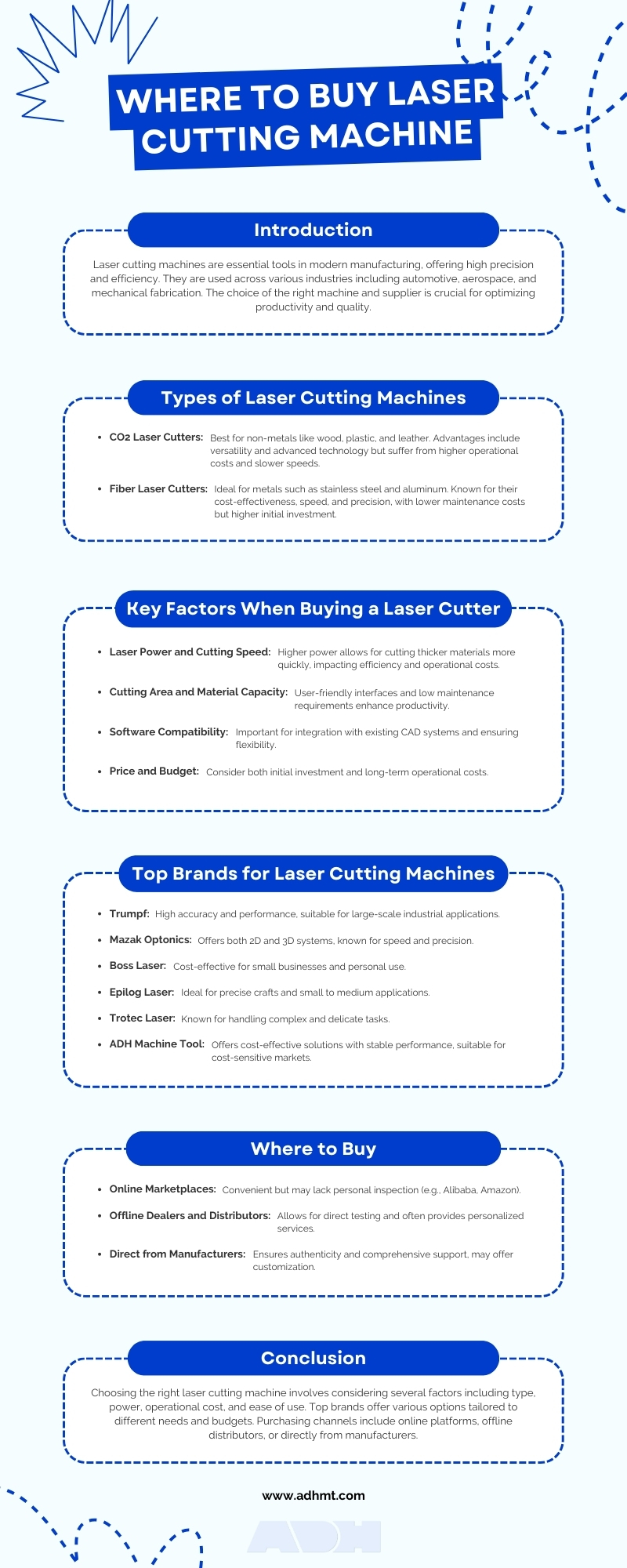
When choosing the ideal laser cutting machine, the question of “where to buy” is just as crucial as “which model to buy.” This guide outlines a variety of purchasing channels—including direct manufacturers, certified professional dealers, and comprehensive online platforms—clearly presenting the unique strengths and features of each option.
Our primary recommendation is to treat your purchasing decision as the beginning of a strategic partnership, rather than a simple transaction. Before making a commitment, thoroughly review the retailer’s after-sales policies, actively seek out genuine user reviews on independent forums and social media, and verify the responsiveness and expertise of their technical support team.
By conducting such a thorough and thoughtful evaluation, you’ll not only acquire a high-performance machine, but also secure a reliable partner who will support your long-term growth and success. If you're ready to find that reliable partner and discuss your specific needs, we encourage you to contact us and speak with our experts.








 English
  العربية
  বাংলা
বাংলা  Български
  Čeština
  Dansk
Dansk  Nederlands
  Deutsch
  Suomi
Suomi  Français
  Ελληνικά
  עִבְרִית
  हिन्दी
  Magyar
  Bahasa Indonesia
  Italiano
  日本語
日本語  Қазақ тілі
  한국어
한국어  Bahasa Melayu
  Norsk bokmål
  فارسی
فارسی  Polski
  Português
  Português do Brasil
  Română
  Русский
  Српски језик
  Slovenčina
  Español de México
  Español
  Svenska
  Kiswahili
  தமிழ்
தமிழ்  Türkçe
  ไทย
ไทย  Tagalog
  Українська
  Tiếng Việt
  اردو
اردو  简体中文
简体中文  香港中文
香港中文  繁體中文
繁體中文