
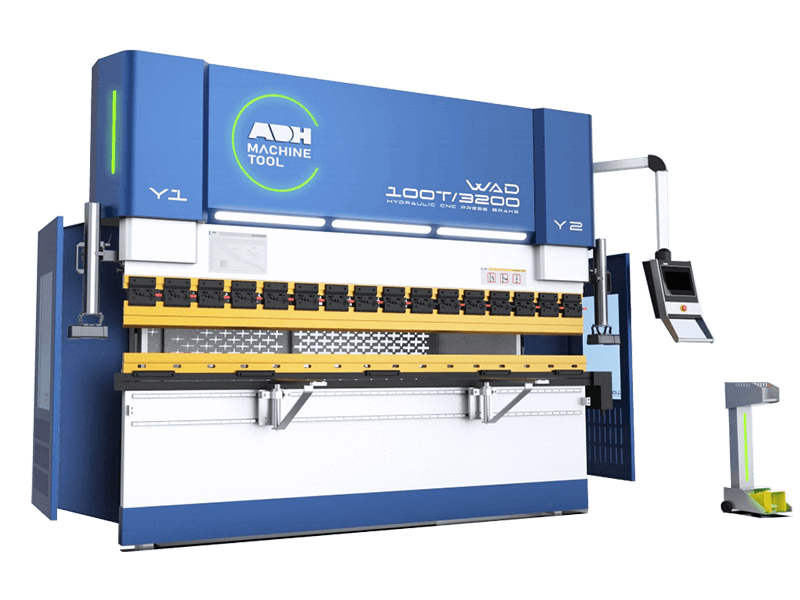
How to Use the Basic Programming of the Press Brake CYBELEC-CybTouch 12 System?
Turn on the power of the press brake. Start up the operating system. First, start the oil pump of the press brake. Click on machine tool referencing. All axes will reset and search for their reference points. Referencing complete. All axes have found their origin points.
Press the run button. The press brake will perform bending according to the current parameters. If it is a simple bending process. For example, single-step bending. You can start programming. This is where you select the material.
Iron, aluminum, stainless steel. This is where you enter the material thickness. The sheet we are bending today is 1.2mm. This is the tensile strength of the material. This is where you select the upper die of the press brake.
Choose the upper die you need. This is where you select the lower die of the press brake. Choose the lower die you need. Next, enter the bending angle. For a 130° bend, enter 130°. For a 90° bend, enter 90°.
This is the size of the back gauge. Currently, it is the external scale. If the external scale is 100mm, after pressing the run button. There will be a bending deduction in the actual running value. It will automatically ensure that the finished external scale is 100mm.
It comes with a sheet thickness deduction for bending. There is another programming method called bending line programming (absolute value programming). Enter 100mm. Press the run button. The x-axis of the back gauge will move to 100mm.
This is the r-axis of the press brake. It automatically generates a suitable position based on the entered back gauge position. It can also be modified. Now, the position of 90.2 is flush with the lower die.
This is the retreat function. After the upper die presses the sheet, the back gauge finger starts to retreat. This is the length of the sheet to be bent. The length of the sheet we are bending is 2500mm. The tonnage is automatically calculated. This is the return stroke.
After bending, the press brake starts to move upward. This is the return stroke opening. If turned off, it will return to the top dead center by default. This is the large arc bending function. This is the bending speed.
Unloading speed. This refers to the unloading speed of the Y-axis moving upward after bending the workpiece. This is the pressure-holding delay. The default value is 0.1 seconds. If the sheet is very thick, you can increase the bending delay.
This is the worktable deflection calculation. This is the clamping point offset. If needed, you can set the speed change point higher. After the die descends, the position of the speed change point can be changed.
Normally, the speed change point is set 4mm above the sheet metal. For example, increase it to 20mm. It will switch to slow speed at the 20mm position. Then the die will descend slowly. This is the counting function.
Enter how many times you need to bend. This is the back gauge finger support function. This is the single-step bending interface. If you need to edit a new program. Click the program list. Select new program.
Start programming. Select material. Select steel. Bending thickness is 1.2mm. Select upper die. Select lower die. Enter bending angle 90°. Switch to inner scale. Enter 15mm for the back gauge position.
The R-axis of the back gauge is automatically calculated. No need to modify. Enter bending length 1500mm. This time there are two bends. Click next step. Add a bending step. Step one 1/2. Step two 2/2. Second bend is 25mm. The program is now edited.
For a complete overview of all programming features and machine specifications, you can download our Brochures.
Click save. ADH. ADH. Click the program list and select ADH. Start bending. Bending in progress. Workpiece display. Angle measurement.
If you have any questions about the operation or would like to discuss your specific bending needs, feel free to contact us.













 English
  العربية
  বাংলা
বাংলা  Български
  Čeština
  Dansk
Dansk  Nederlands
  Deutsch
  Suomi
Suomi  Français
  Ελληνικά
  עִבְרִית
  हिन्दी
  Magyar
  Bahasa Indonesia
  Italiano
  日本語
日本語  Қазақ тілі
  한국어
한국어  Bahasa Melayu
  Norsk bokmål
  فارسی
فارسی  Polski
  Português
  Português do Brasil
  Română
  Русский
  Српски језик
  Slovenčina
  Español de México
  Español
  Svenska
  Kiswahili
  தமிழ்
தமிழ்  Türkçe
  ไทย
ไทย  Tagalog
  Українська
  Tiếng Việt
  اردو
اردو  简体中文
简体中文  香港中文
香港中文  繁體中文
繁體中文