
Imagine the precision of a laser, slicing through aluminum with the finesse of a master sculptor. But can laser cutters cut aluminum? A material known for its high reflectivity and heat conductivity? This guide delves into the fascinating world of laser cutting technology, unraveling the complexities and potential challenges of working with aluminum.
I. Introduction
Laser cutting technology is designed to utilize high-energy laser beams to cut any materials. This technology leads the laser beam via optical and computer numerical control systems (CNC). It uses a movement control system to track the patterns on the materials to be cut based on CNC or G-code. Laser cutting can achieve high-precision cutting, and is suitable for various materials like aluminum.
Aluminum and aluminum alloy materials are widely used in multiple spheres like aerospace, automobile manufacturing, and electronic communications due to their prominent properties like lightweight, good conductivity, and corrosion resistance.
Laser cuts aluminum can produce intricate aluminum components precisely and efficiently. However, aluminum has a strong reflectivity towards laser beams and also has high thermal conductivity, which brings some troubles to some extent to aluminum cutting. Therefore, knowing the processability and restrictions of laser cutting aluminum is of paramount importance for aluminum manufacturing and production.
This may not only involve the understanding of techniques but also the cognition towards aluminum alloy properties, as well as how to overcome the challenges during the metal cutting. What you need to know about laser cutting aluminum?
II. Understanding Aluminum as a Material
1. Final Verdict: Yes, but under extremely demanding conditions
Laser technology can indeed cut aluminum. However, this positive statement hides a critical condition: you must use the right type of laser. In today’s technological landscape, fiber lasers are the only widely accepted mainstream solution for cutting aluminum, while traditional CO₂ lasers are almost entirely excluded from this application—using them forcibly could even risk damaging the equipment.
Aluminum is considered a “difficult material” in laser processing because of two inherent physical properties:
(1) High Reflectivity
At industrial laser wavelengths, aluminum behaves like a mirror. This means that most of the laser’s energy is reflected instantly rather than absorbed, preventing the material from reaching the melting point. More critically, the reflected high-energy beam can travel back into the laser system, potentially destroying the laser head, fiber, or even the laser source itself.
(2) High Thermal Conductivity
Aluminum conducts heat almost five times faster than steel. Even when some energy is absorbed, the heat dissipates quickly into surrounding areas, making it difficult to build up enough heat at the cut point to form a stable molten pool. This leads directly to low cutting efficiency, wide kerfs, excessive dross at the bottom, and heat-induced deformation of the workpiece.
(3) Quick Decision Matrix: Feasibility, Challenges, and Best Use Cases for Various Laser Types Cutting Aluminum
| Attribute | Fiber Laser | CO₂ Laser |
|---|---|---|
| Feasibility | ⭐⭐⭐⭐⭐ Highly recommended; industry standard | ⭐☆☆☆☆ Essentially obsolete; strongly discouraged |
| Physics | Short wavelength (~1.06 μm) with absorption rates in aluminum several times higher than CO₂ lasers; superior beam quality with extremely high energy density to overcome reflectivity barriers instantly | Long wavelength (10.6 μm) with >95% reflectivity in aluminum, leading to extremely low absorption — akin to pouring water on a stone |
| Key Challenges | Reflectivity risk remains; requires high power, precise process parameters, and anti-reflection safety measures; sensitive to overheating thin sheets, demanding fine control | Energy absorption is nearly impossible; cutting is highly unstable; reflected energy can severely damage equipment, making it a danger zone |
| Cutting Speed | Very fast; in medium-to-thin sheet cutting, speeds are 3–5× faster than same-power CO₂ lasers, with excellent economic returns | Extremely slow; even if cutting is marginally possible, efficiency is industrially unviable |
| Cut Quality | Narrow kerf, bright smooth edges, minimal heat-affected zone; with nitrogen assist gas, can achieve near-perfect oxide-free cuts | Wide kerf, rough edges, heavy dross, large taper; quality unsuitable for most industrial standards |
| Operating Cost | High electro-optical efficiency (>30%), virtually maintenance-free, long lifespan, very low operating cost | Low efficiency (~10%), consumable optics and resonator gases, frequent maintenance, high operating costs |
| Best Applications | Suitable for all aluminum thicknesses; optimal for high-precision, high-efficiency, high-quality aluminum processing, especially ≤20 mm | Virtually no aluminum cutting scenarios; better for non-metals (acrylic, wood) and certain thick carbon steels |
(3) Insider Insights: Details Textbooks Don’t Cover
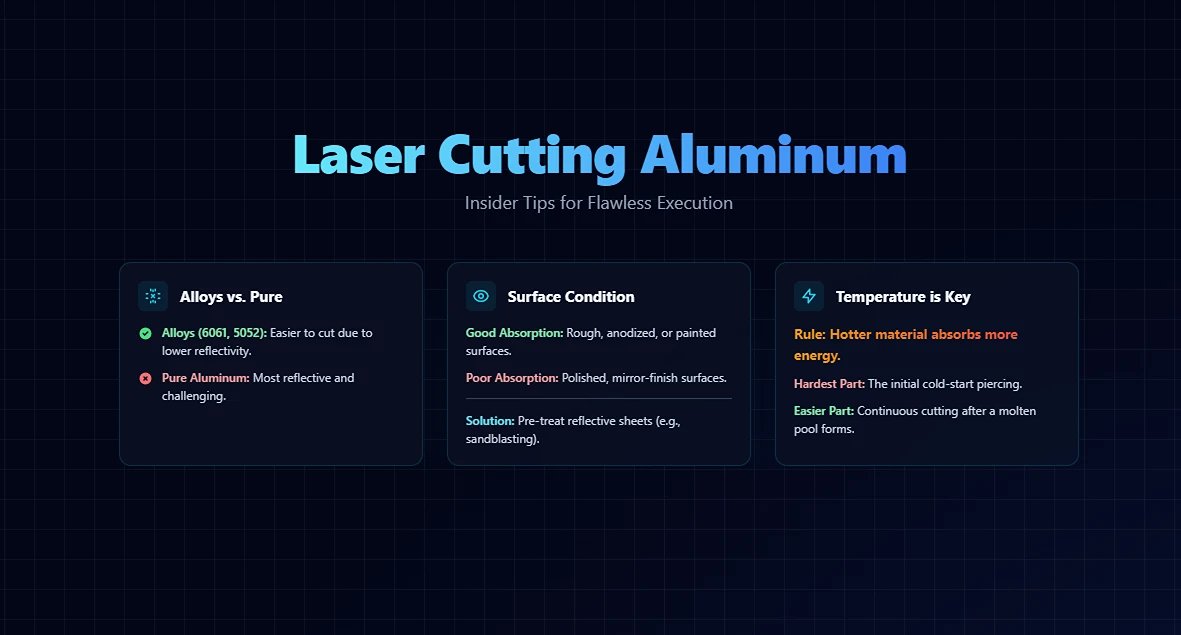
1)Alloys are easier than pure aluminum: Pure aluminum has the highest reflectivity and is the most challenging to cut. Most common aluminum alloys (e.g., 6061, 5052) contain elements like silicon and magnesium that slightly lower reflectivity and alter heat conductivity, making them more laser-friendly.
2)Surface condition is critical: Rough, anodized, or painted aluminum surfaces absorb laser energy significantly better than polished mirror-finish surfaces. For highly reflective sheets, pre-treatments like sandblasting or scribing can greatly improve piercing success rates.
3)Temperature is a game-changer: The hotter the material, the more laser energy it absorbs. This makes the first step—cold-start piercing—the toughest part of the process. Once a molten pool forms, continuous cutting becomes smoother thanks to preheating.
2. Who This Guide Is For: Pinpointing Your Professional Needs
This in-depth analysis is crafted for professionals on the manufacturing frontlines, aimed at resolving the real challenges you face in your daily work:
(1) For Engineers & Designers
Gain precise design guidance, understanding how laser cutting impacts part tolerances, sharp corners, and heat-affected zones so you can avoid manufacturing pitfalls from the outset.
(2) For CNC Operators & Technicians
Acquire a practical process-setting framework (covering power, speed, assist gas pressure, focal positioning) and learn to diagnose and resolve defects such as dross formation, burnt edges, and incomplete cuts.
(3) For Equipment Buyers & Business Decision-Makers
Access a clear investment playbook to evaluate laser cutting solutions based on technical feasibility, cost-effectiveness, and ROI timelines—helping you choose what best aligns with strategic goals.
3. Why Laser Cutting is a Strategic Choice
Despite its technical hurdles, laser cutting remains an irreplaceable tool in aluminum processing, especially in industries striving for performance excellence like automotive lightweighting, aerospace, and consumer electronics. Its strategic value is unmatched:
(1) Unparalleled Precision and Flexibility
Achieve ±0.05 mm accuracy with ease, enabling complex geometries and micro-features that are impractical for stamping or milling. No tooling is required—designs move straight from CAD files to finished parts, greatly accelerating product development cycles.
(2) Exceptional Processing Quality
With optimal parameters (especially high-pressure nitrogen assist), lasers produce edges that are mirror-smooth, burr-free, and oxidation-free—often ready for welding or assembly without secondary finishing, boosting efficiency and quality.
(3) High Speed and Material Utilization
Extremely fast cutting combined with advanced nesting software maximizes sheet utilization, significantly reducing waste of expensive aluminum, which is a major cost saver in mass production.
(4) Non-Contact Processing Advantages
The beam never physically touches the workpiece—no tool wear, no cutting forces to warp thin sheets. This is a key advantage for thin-walled, intricate, or high-surface-finish aluminum components.
Ⅲ. Diving into the Science: Why Aluminum Resists Laser Cutting
To truly master aluminum laser cutting, one must become a kind of “materials psychologist,” understanding from a physics standpoint why aluminum can be so uncooperative. Its two core properties—high reflectivity and high thermal conductivity—act as robust physical barriers, defining one of the laser processing industry’s most recognized challenges.
1. Challenge One: High Reflectivity — The Problem of “Energy Bounce-Back”
(1) The Physics Behind It: Why Does Aluminum’s Surface Reflect Laser Light Like a Mirror?
Metals are defined by their sea of free-moving electrons. When a laser—an intense electromagnetic wave—strikes the surface of aluminum, these electrons oscillate rapidly in sync with the laser’s electric field. This collective vibration generates a new electromagnetic field that travels in the opposite direction, effectively reflecting most of the incoming energy straight back. For infrared wavelengths commonly used in industrial lasers, a polished aluminum plate can reflect more than 95% of the incident beam.
(2) Wavelength Determines Success: Why a 1μm Fiber Laser Absorbs Far Better Than a 10.6μm CO₂ Laser
A material’s absorption rate for laser energy depends heavily on the wavelength. This is the key that allows fiber lasers to “tame” aluminum.
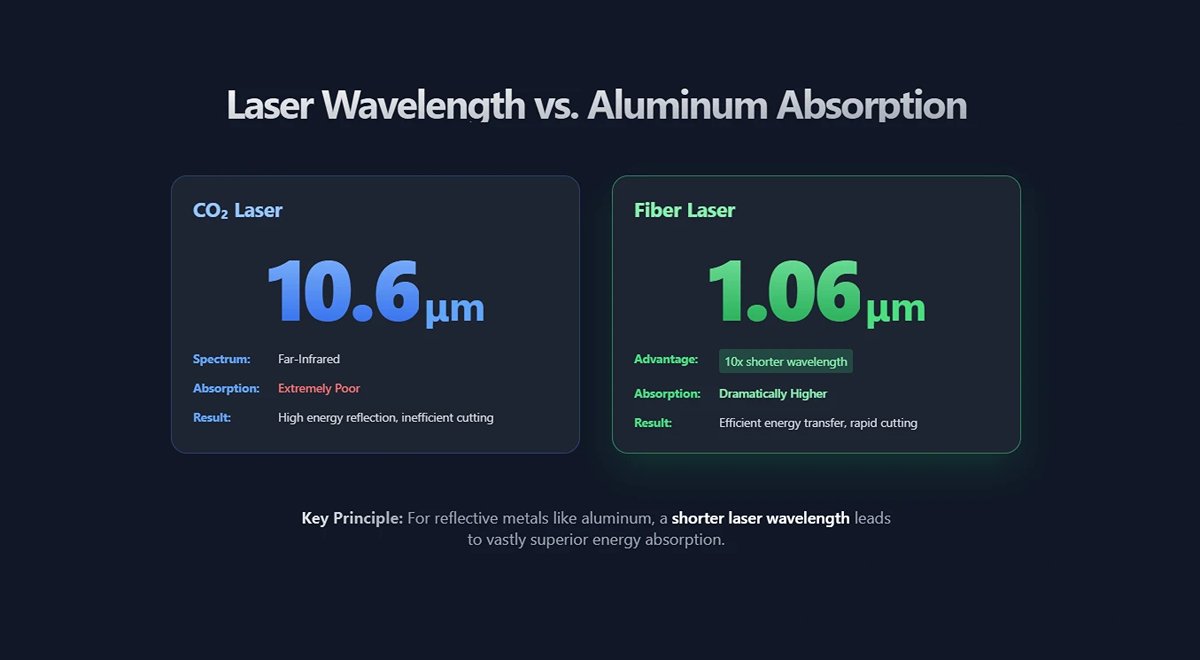
1)CO₂ Laser (10.6μm wavelength): Operating in the far-infrared range, aluminum’s reflectivity is at its peak in this band, making absorption extremely poor. Most of the energy is bounced away instantly, preventing efficient heating of the workpiece. Cutting under these conditions is like trying to carve stone with water.
2)Fiber Laser (about 1.06μm wavelength): This lies in the near-infrared range, ten times shorter than a CO₂ laser’s wavelength. At this shorter wavelength, aluminum’s absorption rate dramatically improves—often several times, or even tenfold, compared to CO₂ under the same conditions. The higher absorption lets the beam transfer energy efficiently into the metal, enabling rapid molten pool formation and initiating the cut.
(3) The Hidden Danger: How Back-Reflection Can Destroy Laser Heads and Optics
“Energy bounce-back” doesn’t just cripple cutting efficiency—it poses a serious threat to the equipment through back-reflection damage. Since the beam is usually directed vertically at the workpiece, reflected high-energy light often travels back along its original path, heading straight into the cutting head, optical fiber cable, and even the laser source itself.
Lasers are engineered to emit energy, not receive it. Unwanted reflected power can cause precision optical parts—such as focusing or collimating lenses—to overheat rapidly, triggering thermal stress, coating burnout, or even catastrophic fracture. In the worst case, this can destroy a laser source worth tens or hundreds of thousands of dollars.
(4) Insider’s Note: Survival Rules Beyond the Textbook
Modern high-end fiber lasers are not defenseless—they typically feature sophisticated back-reflection protection systems. These act like an impenetrable shield, using components such as Faraday isolators to divert the returning beam into a “beam dump” for safe conversion to heat, allowing continuous, stable cutting of reflective metals.* Reflection isn’t limited to the start of the process. Once a molten pool forms, the liquid metal surface itself behaves like a mirror, producing intense reflections. Effective back-reflection protection must be in place for the entire duration of the cut.
2. Challenge Two: High Thermal Conductivity — The Struggle Against Heat Dissipation
(1) Heat Transfer Mechanics: Why Does Aluminum Spread Heat So Quickly, Preventing a Stable Molten Pool?
Even when some laser energy is successfully absorbed, another problem quickly emerges: aluminum is an excellent heat conductor with a thermal conductivity of 237 W/(m·K)—nearly five times that of carbon steel. This means heat generated at the laser spot dissipates rapidly into the surrounding cooler material instead of staying concentrated at the point of impact.
It’s like trying to ignite a massive block of ice with a single match—the moment heat is introduced, it vanishes into the surrounding mass. This fast loss of heat makes it hard to accumulate enough temperature at the focal point to maintain a stable molten pool, turning the cutting process into a struggle that easily stalls.
(2) Cutting Consequences: Dross, Warping, and Poor Edge Quality
Poor thermal control often leaves behind a range of defects in the finished piece:
1)Dross/Slag: Inadequate heat at the cut site means molten metal cools and solidifies before it can be fully blown away by assist gas. The stubborn residue clings to the underside of the cut edge, degrading quality and raising post-processing costs.
2)Thermal Warping: Uneven heat distribution creates large internal stresses, which for thin sheets often result in warping or distortion once the cut is complete—compromising flatness and assembly precision.
3)Excess Kerf Width & Enlarged Heat-Affected Zone (HAZ): Operators may slow cutting speed or raise laser power to counter rapid heat loss, but this can backfire—higher energy input widens the cut and expands the HAZ. Material near the cut edge may undergo microstructural and mechanical changes, reducing strength and toughness.

3. Key Variables: Alloy Grade and Surface Condition
Not all aluminum is created equal. Alloy composition and surface condition are the third critical factors determining cutting success.
(1) Common Alloy Overview: How Added Elements Affect Cut Quality
Different aluminum alloys incorporate elements like copper, magnesium, silicon, or zinc, which alter their optical and thermal characteristics—directly influencing laser cutting performance.
1)General Rule: Alloying typically lowers aluminum’s reflectivity and modifies its thermal conductivity, which is why pure aluminum (like the 1xxx series) is often more difficult to cut than its alloyed counterparts.
2)5xxx Series (e.g., 5052) and 6xxx Series (e.g., 6061): These alloys are popular “star materials” in laser cutting, offering good formability, moderate strength, and excellent corrosion resistance. They cut cleanly and consistently, with 6061 especially prized for its ideal balance of strength and machinability.
3)7xxx Series (e.g., 7075) and 2xxx Series (e.g., 2024): Aerospace-grade alloys with high strength and hardness. They generally require higher laser power and precise parameter control to avoid micro-cracks—but modern high-power lasers handle them well.
(2) Impact of Surface Condition: Cutting Strategies for Anodized, Coated, or Film-Laminated Aluminum
The state of the aluminum’s surface is a critical variable—it can dramatically change the initial interaction between laser light and the material.
1)Anodized Aluminum:
The anodized layer on its surface—composed primarily of Al₂O₃—is a ceramic material with an exceptionally high melting point (around 2072°C), far above the 660°C of the aluminum substrate. This means the laser must deliver an extremely high peak power in an instant to break through this tough outer shell. Interestingly, once the layer is penetrated, the rest of the cutting process becomes comparatively easy. A clever application of this property is that lasers can precisely ablate the oxide layer without damaging the base metal, allowing low‑power CO₂ or diode lasers to create intricate engravings and markings on anodized aluminum that stand out with striking visual contrast.
2)Coated or Laminated Aluminum Sheets:
Surface treatments such as paint, powder coating, or even dark markings left by a permanent marker can serve as an anti‑reflective layer, significantly boosting the material’s initial laser energy absorption and reducing reflectivity. This greatly assists in initiating piercing and cutting. However, as these coatings vaporize during cutting, they generate smoke and particulates—making an efficient workshop ventilation and extraction system essential.
3)Surface Cleanliness:
Never underestimate the importance of a clean surface before cutting. Oil, dust, and uneven natural oxide films can act as invisible barriers, disrupting consistent laser energy absorption and directly compromising cut quality—or even causing complete failure. In high‑precision fields such as aerospace, advanced pre‑treatment methods like laser cleaning may be used to achieve an ultra‑clean surface, laying the groundwork for flawless cutting and welding.
4. Physical properties of aluminum
Aluminum is a material that possesses many kinds of physical properties. It is a solid, nonmagnetic, matte, and silver-white metal with a slight blue tint.
The surface of aluminum is highly reflective and features a face-centered cubic structure, which is stable before melting.
The density of aluminum is low, non-toxic, has high thermal conductivity, and excellent corrosion resistance, which can easily be manufactured, fabricated, and shaped.
What’s more, aluminum has good ductility and plasticity, which can be torn to lines or rolled into thin foil.
5. Common applications of aluminum in various industries
Aluminum is widely applied in multiple spheres. For example, aluminum can be used in the construction area to produce window frames, curtain walls, roofs, cladding, structural elements, and interior components.
In the food and pharmaceutical industry, large parts of aluminum are used to package food, drugs, and beverages because it will not affect the smell of the food, and keep and repel moisture.
6. Why aluminum is a popular choice for laser cutting projects
The reason for aluminum to be chosen for laser cutting programs is that its soft and plastic molecular structure makes the laser not penetrate utterly.
The high thermal conductivity means that it can quickly absorb the energy from the laser, which is beneficial to create clean cuts with no burrs, or minimum burs.

Despite this, laser cutting aluminum is not easy, it requires special techniques and equipment to handle the high thermal conductivity and optical reflectivity of the material.
Through using different levels of aluminum (like 6061, 5052, 5083, and 7075), laser cutting technology can process it efficiently to meet specific needs.
Ⅳ. The Right Tools for the Job: Mastering the Ultimate Gear for Cutting Aluminum
Now that we’ve uncovered the physics behind aluminum’s resistance to laser cutting, it’s time to move into the practical realm of “to do a good job, one must first sharpen one’s tools.” Successfully cutting aluminum is far from an improvised performance—ordinary laser machines won’t cut it. It’s an intricate technical symphony where the laser source, assist gas, and optical system work in perfect harmony. Every choice and adjustment is like a note in a score that together define the quality and efficiency of the finished product.
1. The Core Power Unit: The Ultimate Showdown of Laser Types
Choosing the right laser is your first—and most critical—decision when cutting aluminum. In this contest, the winner has long been decided.
(1) Fiber Laser: The Undisputed King
In modern aluminum processing, the fiber laser reigns supreme with overwhelming advantages on all fronts.
1)Dominance at the Physical Level:
With its ~1µm short wavelength, it perfectly matches aluminum’s absorption “sweet spot,” delivering energy utilization efficiency an order of magnitude higher than CO₂ lasers—effectively solving the problem of “energy bounce-off.”

2)Exceptional Beam Quality (High BPP):
Fiber lasers concentrate their energy into a minuscule, blazing-hot spot, allowing for narrower kerfs, smaller heat-affected zones, and the capability to follow intricate contours—foundational for precision cutting.
3)Outstanding Electro-Optical Conversion Efficiency:
Exceeding 30% (with top models surpassing 50%), fiber lasers set the benchmark for energy savings, dramatically reducing operating costs compared to CO₂ lasers while aligning with modern manufacturing’s green and low-carbon goals.
4)Rock-Solid Reliability:
As all-solid-state machines, their core components are sealed inside the optical fiber. They require virtually no maintenance, no optical mirror changes, and no gas replacement—delivering long-term stable performance even in demanding industrial environments.
5)Built-In “Armor”:
Today’s mainstream fiber lasers integrate advanced back-reflection protection systems that safely detect and handle the intense reflections generated when cutting aluminum, ensuring the safety of the equipment and allowing operators to tackle high-reflectivity materials with confidence.
(2) CO₂ Lasers: Struggling in the Aluminum Arena
While CO₂ lasers once dominated cutting of nonmetals and thick carbon steel, they falter when faced with aluminum and have been largely swept aside by newer technologies.
1)A Physical Barrier They Cannot Overcome:
Their 10.6µm long wavelength is heavily reflected by aluminum’s smooth surface. Standard-power CO₂ lasers often fail to even initiate a stable cut, making attempts as futile as climbing a tree to catch fish.
2)A Double Bind of High Risk and Low Efficiency:
Even with multi-kilowatt CO₂ lasers, forcing cuts in thin aluminum is erratic and slow. Worse, their optics are extremely sensitive to back reflections—one stray reflection can destroy expensive lenses or even the laser source itself.
3)Lingering “Historical Value”:
Before fiber lasers became widespread, some factories used ultra-high-power CO₂ lasers with special techniques (like black surface coatings) to cut thicker aluminum plates. But cut quality, speed, and overall cost efficiency lag far behind today’s fiber technology. Their remaining utility now lies mainly in squeezing performance out of older, existing equipment.
(3) Insider Insight: The Nonlinear Game Between Power and Thickness
A common misconception is that doubling laser power doubles the thickness you can cut. For aluminum, this is a dangerous trap. As thickness increases, heat loss through conduction grows exponentially. Cutting thicker plate demands disproportionately higher power to compensate for this loss.
For example, moving from 10mm to 20mm may require triple the power—or more—not just double. The New Frontier of Ultra-High Power: The commercialization of 20kW, 30kW, and even 40kW+ fiber lasers has shattered thickness limits. Consistently cutting 30mm, 40mm, or even thicker aluminum is now achievable—a feat unimaginable just a few years ago. This is reshaping the landscape, challenging plasma and waterjet cutting in the heavy aluminum sector.
(4) Power Matching Guide: Quantitative Reference for Laser Power vs. Aluminum Thickness
Selecting the right power is a balancing act between efficiency, quality, and investment cost. The following chart is distilled from extensive industry data, but remember: optimum settings should always be fine-tuned through testing with your specific equipment, aluminum alloy grade, and gas purity.
| Aluminum Thickness (mm) | Recommended Fiber Laser Power (W) | Key Considerations and Decision Insights |
|---|---|---|
| ≤ 3mm | 1,500W – 3,000W | In this thin sheet range, power mainly affects speed. 1.5kW is a highly cost-effective starting point, while 3kW delivers maximum productivity—ideal for high-volume production. |
| 4mm – 8mm | 3,000W – 6,000W | This is the most competitive segment in the market. 3kW will do the job, but 6kW offers a broader process window and superior edge quality—making it a versatile, high-quality choice. |
| 9mm – 15mm | 6,000W – 12,000W | At this range, 6kW starts to struggle. 12kW lasers consistently provide efficient, bright-edge cuts—your ticket to premium thick-plate work. |
| 16mm – 25mm | 12,000W – 20,000W+ | Heavy plate territory requires high power to overcome thermal conduction losses and ensure full penetration with clean edges. 20kW dramatically boosts throughput. |
| > 25mm | 20,000W – 40,000W+ | The stage for ultra-high-power lasers—serving heavy structural components, molds, and specialized defense applications. Requires exceptional equipment, processes, and operator skill. |
2. Decisive Factor: Strategic Selection of Assist Gas
If the laser is the engine, then the assist gas is the fuel and lubricant determining performance. It doesn’t just blow away molten metal—it directly influences the cut edge’s chemistry and final appearance. Choosing wisely here is critical.
(1) Nitrogen (N₂): The Choice for High Quality
Nitrogen is the industry’s gold standard for producing bright, clean aluminum cut edges.
1)Mechanism of Action:
As an inert gas with exceptional chemical stability, nitrogen forms a protective barrier in the cutting zone, shielding molten aluminum completely from atmospheric oxygen. It doesn’t participate in chemical reactions—its sole purpose is to use sheer physical force via high-pressure flow to swiftly expel molten droplets from the bottom of the kerf.
2)Cut Quality:
The resulting edge retains aluminum’s natural silvery-white metallic sheen, free from oxidation, with an exceptionally smooth finish. This “what you see is what you get” high-quality edge eliminates the need for secondary finishing and is ready for high-spec welding or coating, ensuring maximum weld strength and coating adhesion.
3)Core Process Principle:
High pressure is key. Due to the relatively high viscosity of molten aluminum, cutting operations typically require nitrogen pressure in the range of 10–20 bar (1–2 MPa), or even higher. This ensures a powerful, focused gas stream capable of penetrating the entire thickness of the sheet, completely clearing out molten debris and preventing stubborn slag from adhering to the underside.
4)Compressed Air:
Essentially, compressed air is a mixture of around 78% nitrogen and 21% oxygen — a cost-focused middle ground between pure nitrogen and pure oxygen.
- Operating Mechanism: The nitrogen component primarily provides protection and assists in debris removal during the cut, while the small proportion of oxygen inevitably triggers mild oxidation, subtly affecting edge quality.
- Cut Quality: Cutting speeds are generally a bit faster than with pure nitrogen, but edge quality suffers. The cut surface often appears pale yellow or light gray with a thin oxide layer. While still far superior to cuts made with pure oxygen, it falls short for parts requiring high-precision welding or premium coating.
- Best Use Cases: The main advantage here is ultra-low cost (requiring only a compressor, storage tank, and filtration/drying system). Suitable for parts where edge quality is not critical and no secondary processing is required, such as internal structural components, gaskets, or thin sheets without appearance requirements.
- Oxygen (O₂): A Double-Edged Sword — Prohibited in Aluminum Cutting

Unless there is an exceptionally specific process requirement, oxygen should never be used for cutting aluminum.
- Operating Mechanism: As a highly reactive gas, oxygen undergoes an intense, uncontrolled exothermic oxidation reaction with molten aluminum at high temperatures. While such a reaction can aid heating and speed in carbon steel cutting, for aluminum it is catastrophic.
- Undesirable Results: This reaction produces large amounts of hard, fluffy, black aluminum oxide (Al₂O₃) that completely coats the cut surface, leaving it extremely rough. The uncontrolled chemical reaction severely erodes the cut edge, destroying dimensional accuracy and rendering the part unusable.
| Assist Gas | Cut Quality | Cutting Speed | Operating Cost | Primary Application |
|---|---|---|---|---|
| Nitrogen (N₂) | Excellent (bright, oxide-free, smooth) | Fast | High | All aluminum cutting applications demanding high quality, especially for precision welding, anodizing, or premium coating parts. |
| Compressed Air | Moderate (light oxidation, yellowing, somewhat coarse) | Fairly Quick | Ultra Low | Thin sheet cuts where edge quality is non-critical and cost reduction is the primary goal. |
| Oxygen (O₂) | Very Poor (severe oxidation, blackening, extremely rough) | - | Medium | Rarely used in aluminum cutting; considered a strict no-go. |
3. Precision Control Systems: The Art of Fine-Tuning Optics and Nozzles
Once you have both a powerful energy source and the right assist gas, the final decisive step lies in precisely controlling the beam shape and airflow path — a blend of seasoned experience and applied science.
(1) Focal Position: The Key Parameter Shaping the Kerf
Focal position refers to where the laser’s smallest, most concentrated spot — the beam waist — sits vertically relative to the workpiece surface. It directly affects kerf width, verticality, and the final surface profile.
1)Positive Focus (+): The focal point sits above the workpiece surface. Primarily used for high-speed piercing of thin sheets, rarely employed for cutting.
2)Zero Focus (0): The focal point is exactly at the workpiece surface. Typically used for ultra-thin materials under 1 mm to achieve the narrowest possible kerf.
3)Negative Focus (-): The focal point is positioned below the workpiece surface. This is the standard choice for cutting most aluminum, especially mid-to-thick plates.
(2) Insider Insight: Why Negative Focus is the 'Golden Rule' of Aluminum Cutting
When cutting thick aluminum plate, a significant negative focus is often used (for example, for 10 mm plate, the focal point may be set halfway through at –5 mm). The reasoning is two-fold:
1)Ensuring Full-Section Energy Delivery: Due to aluminum’s high thermal conductivity, the laser must maintain high power density throughout the cut depth. Positioning the focal point in the lower half allows the beam to widen slightly at the top, creating a broader opening for gas flow, while keeping the energy concentrated at the bottom to sustain melting.
2)Optimizing Slag Removal Path: This “wide-top, narrow-bottom” beam profile, combined with high-pressure nitrogen, mimics a Venturi effect, greatly accelerating debris evacuation and producing a smooth, vertical finish.
(3) Nozzle Selection: Sculpting Airflow and Slag Removal Performance
The nozzle is the final checkpoint guiding assist gas precisely into the cutting zone. Its design and condition dictate airflow shape, velocity, and pressure, making it the critical “last mile” in achieving a perfect cut.
1)Nozzle Type:
For aluminum cutting with nitrogen, use a single-layer nozzle. Its simple straight or converging design produces a fast, high-pressure, well-collimated laminar gas stream for optimal debris clearing. Double-layer nozzles are designed for oxygen cutting of carbon steel and disrupt airflow, making them unsuitable for high-pressure nitrogen cutting.
2)Nozzle Orifice Size:
Aperture size directly dictates gas flow rate and velocity. For highly thermally conductive aluminum, larger apertures (e.g., 2.0–4.0 mm) are typically required to supply enough cooling gas and produce a strong jet to expel viscous molten debris. Too small and slag removal becomes difficult; too large and the gas disperses, reducing central pressure and wasting supply.
3)Nozzle Stand-off Height:
The gap between the nozzle tip and the workpiece surface is usually controlled precisely between 0.5 mm and 1.5 mm. Too high and the airflow diffuses before hitting the workpiece, weakening protection and debris removal. Too low and the nozzle risks colliding with warped material or becoming clogged by spatter, leading to cut failure.
4)Beam Quality (M²): The Laser’s Cutting Talent
Beam quality is quantified by the M² (M-squared) factor, a measure of how closely a real laser beam approximates the ideal Gaussian beam. The closer M² is to 1, the higher the quality — indicating greater inherent performance.
IV. Step-by-Step Guide to Laser Cutting Aluminum
1. Design Preparation
Using CAD Software
- Utilize industry-standard software like AutoCAD, SolidWorks, or CorelDRAW to create or import designs optimized for laser cutting.
- Consider material thickness, minimum feature size, kerf width, and nesting strategies to maximize material usage.
- Validate designs using simulation tools to detect potential issues before production.
2. Material Selection
Choosing Aluminum Alloys
1)Select alloys based on application requirements:
- Aerospace: 6061, 7075 for strength and corrosion resistance.
- Automotive: 5052 for formability and fatigue strength.
- Architectural: 6063 for aesthetic finishes.
2)Ensure material cleanliness by removing contaminants like oils or dirt that could interfere with laser efficiency.

3. Machine Setup
Setting Up the Laser Cutter
- Install proper focusing lenses and ensure standoff distance between the nozzle and workpiece is optimal.
- Calibrate laser power density and focus point to avoid scattering on reflective surfaces like aluminum.
- Ensure proper ventilation and secure the aluminum sheet flat on the cutting table to prevent movement during cutting.
4. Parameter Optimization
Adjusting Cutting Parameters
- Set laser power, cutting speed, assist gas type (e.g., nitrogen), gas pressure, and focal point position based on aluminum thickness and alloy properties.
- Use pre-programmed settings for common materials or fine-tune parameters manually for optimal results.
- For pulsed lasers, adjust pulse frequency to minimize heat distortion and achieve precise cuts.
5. Test Cutting
Conducting Initial Trials
- Perform test cuts on small sections of the material to verify parameter settings.
- Adjust parameters based on edge quality, dross formation, or thermal effects observed during testing.
6. Full Production Run
Monitoring Consistency
- Proceed with production after successful test cuts. Monitor the process for consistent quality using automation tools or AI-driven systems for real-time adjustments.
- Implement thermal management strategies such as cooling systems or periodic cool-down intervals for larger jobs to prevent heat buildup.
7. Post-Processing
A flawless cut marks only the birth of the part—the very first step in its journey. Equally critical are the subsequent finishing and inspection processes, which ultimately define the product’s delivery standards.
(1) Deburring and Dross Removal Techniques
Even with the most refined process, laser-cut aluminum edges—especially on the underside—may still carry small burrs or traces of dross.
(2) Manual Processing
Involves using hand tools such as files, sandpaper, or scrapers. This low-cost approach is less efficient and offers inconsistent results, making it more suitable for small production runs or irregularly shaped components.
(3) Mechanical Processing
The wide-belt deburring sander currently stands as the most efficient automated solution. It feeds parts along a conveyor through rotating abrasive belts or brush rollers, quickly and evenly removing burrs and sharp edges from flat parts, with the option to apply a brushed surface finish.
(4) Other Methods
Techniques such as tumbling, sandblasting, and electrochemical polishing are also employed for deburring and surface finishing in specific scenarios.
(5) Evaluation Standards: Quantifying Quality
Product inspection serves as the foundation for ensuring quality and driving continual process optimization.
(6) Perpendicularity and Taper
Verified using a square, optical projector, or coordinate measuring machine to assess the perpendicularity of the cut wall relative to the sheet surface. High-quality cutting minimizes taper to a negligible degree.
(7) Roughness (Ra)
Measured with a surface profilometer to assess the smoothness of the cut. Bright surfaces achieved via high-pressure nitrogen cutting can easily reach an Ra value of 3.2–6.3 μm, delivering exceptional quality with a smooth tactile feel.
(8) Heat-Affected Zone (HAZ) Width
A key metric for evaluating thermal damage, critical to preserving the material’s performance. This typically involves sectioning the sample, polishing, etching, and then examining the microstructural change zone under a metallographic microscope. In aluminum alloys, an overly wide HAZ can reduce local hardness and strength—one of the major advantages of laser cutting is its remarkably narrow HAZ.
8. Troubleshooting Common Issues
(1) Improving Edge Quality
Poor edge quality: Adjust laser power settings to match material thickness; optimize cutting speed to balance vaporization efficiency and heat input.
(2) Managing Overheating
Use shorter pulse durations or increase assist gas flow rates to dissipate heat effectively during cutting.
(3) Resolving Kerf Width Issues
Reduce gas pressure or adjust focus height if kerf width is too wide; clean material surface to improve precision.

9. Impact of Aluminum Alloys on Laser Cutting
(1) Alloy-Specific Challenges
Reflectivity: Higher in alloys with magnesium or copper content; requires higher power density lasers or anti-reflective coatings for effective cutting.
(2) Thermal Conductivity Variations
Alloys like silicon-enhanced aluminum dissipate heat faster, requiring adjustments in laser parameters (e.g., slower speeds).
V. Types of Lasers Suitable for Cutting Aluminum
Generally speaking, fiber lasers, CO2 lasers, and other solid-state lasers can cut metal.
1. Fiber Lasers
Fiber lasers are highly effective for cutting aluminum due to their powerful energy density and precise beam quality. They can focus energy into a very small spot, allowing for precise and efficient sheet metal cutting, even with reflective materials like aluminum.
Advantages of Fiber Lasers
- High Efficiency and Speed: Fiber lasers convert energy efficiently and achieve rapid cutting speeds, boosting productivity.
- Minimal Heat-Affected Zones: The focused energy results in minimal thermal deformation of the material.
- Versatility: Fiber lasers can cut various thicknesses and alloys of aluminum, making them suitable for a wide range of applications.
2. Crystal Lasers (Nd: YAG and Nd: YVO4)
Crystal lasers, such as Nd: YAG and Nd: YVO4, share similar wavelengths with fiber lasers, making them suitable for cutting aluminum sheets. These lasers are often used in applications where fiber lasers are either unavailable or not required.
Features of Crystal Lasers
- Precision Cutting: They offer precise cutting capabilities, suitable for detailed work.
- High Beam Quality: These lasers provide excellent beam quality, essential for clean cuts.
- Flexibility: Crystal lasers can be used in various industrial applications where high precision is needed.
3. CO2 Lasers
CO2 lasers are another type of laser used in cutting applications, though they are generally less efficient for cutting aluminum due to the material's high reflectivity and thermal conductivity.
Limitations of CO2 Lasers
- Reflectivity: Aluminum’s reflectivity scatters CO2 laser beams, lowering their effectiveness.
- Thermal Conductivity: Aluminum dissipates heat quickly, requiring higher laser power and speed to achieve clean cuts.
- Application Suitability: CO2 lasers are more commonly used for non-metallic materials like wood and acrylic, where they perform exceptionally well.
VI. Advantages of Laser Cutting Aluminum
1. Precision and Accuracy in Cutting
Laser cutting can achieve extremely high precision, which is one of its biggest advantages. Modern laser cutting machine’s positioning precision can be up to 0.02 mm, and width of slit width is smaller than 0.2 mm. This high precision makes laser cutting able to produce complex shapes, and precise sizes of aluminum parts, which can meet the high requirements in aerospace, electronics, and other industries.
What’s more, laser cutting can proceed repeatedly, which can cut the workpiece in the same way, further improving its precision and accuracy.
2. Clean Edges and Minimal Material Wastage
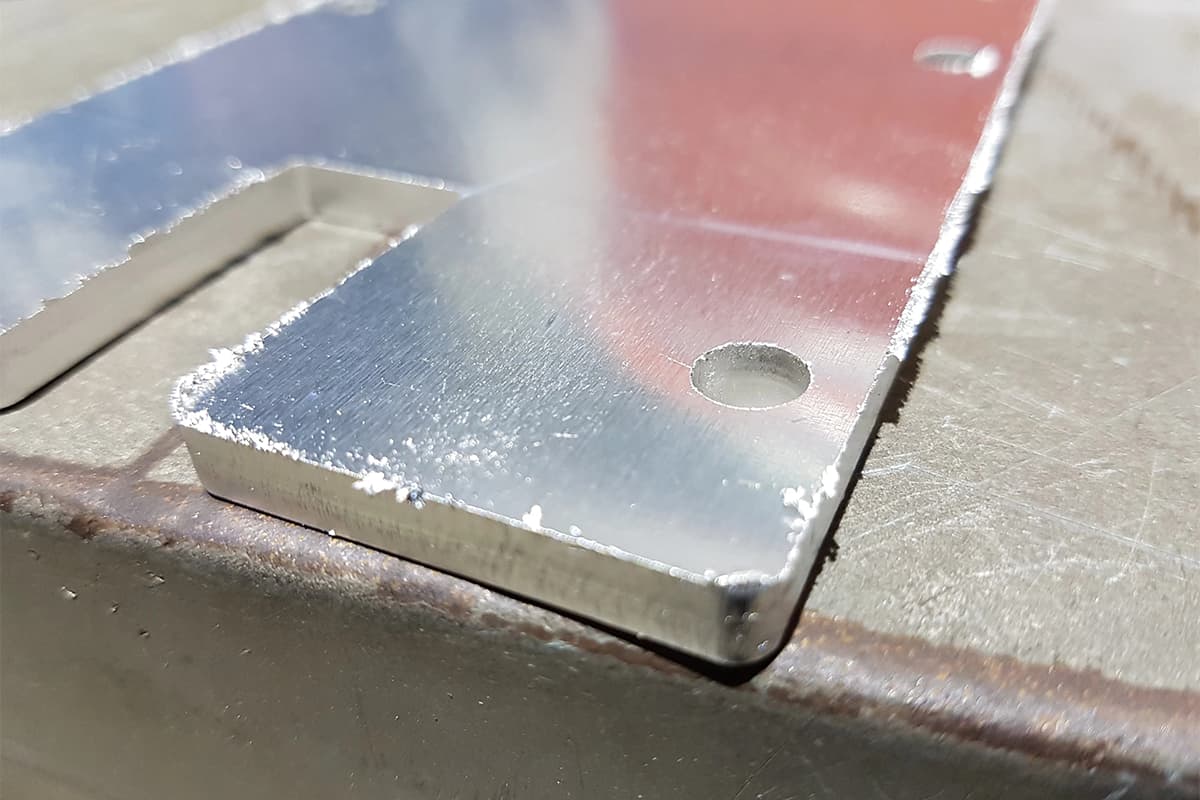
When laser cuts the aluminum, the melted material is blown away by high-speed airflow, and the cuts are flat and smooth, rarely generating burrs, and no need for second processing like grinding and other processes. The slit is narrow, small heat-affected zone, and high material utilization rate. Compared with traditional mechanical cutting, laser cutting can greatly reduce material waste, saving cost.
3. Versatility in Creating Intricate Designs
Laser cutting features non-contact fabrication, and the laser head can move flexibly and cut any complex patterns.
Via programming control, laser cutting machines can cut various shapes of workpieces quickly and constantly, such as aluminum decorative parts on automobiles and electronic products, etc., offering wide design freedom. The flexibility of laser cutting also makes it become the ideal choice for making custom projects.
VII. Limitations of Laser Cutting Aluminum
1. Heat Affected Zones and Potential Distortion
The heat affected zone generates surrounding the cuts when laser cuts. The material will undergo changes in its organizational structure and properties in this area.
The aluminum has good thermal conductivity, and heat affected zone is relatively large, especially apparently when thick sheets are cut.
Over large heat input may lead to aluminum deformation, affecting the component precision. Therefore, reasonably controlling the laser power and cutting speed is necessary, decreasing the heat-affected zone influence.
2. Surface Quality Issues
Although laser-cutting aluminum can acquire relatively smooth cuts, there are still some surface problems existence under some circumstances.
The cut surface may show defects such as streaks, roughness, and slag adhesion, especially when cutting thick aluminum plates or highly reflective aluminum alloys.
These defects will affect the appearance of the components and using properties. The cutting process parameters need to be optimized. And the cuts need to be handled like polishing, deburrs and so on.
3. Thickness Constraints for Efficient Cutting
Laser cutting may have limitations in the aluminum thickness to some extent. Generally speaking, a high-power laser cutting machine can cut an aluminum sheet over 10 mm thick, but the cutting efficiency and quality will decrease.
Over 20 mm thick aluminum sheet is difficult to acquire satisfying cut quality via laser and probably needs other cutting methods. Besides, the type of aluminum also affects cutting thickness.
Pure aluminum has high reflectivity, which is difficult to cut, and high silicon aluminum limits the thickness that can be cut due to its low melting point.
VIII. Applications of Laser-Cut Aluminum

1. Examples of Industries Using Laser-cut Aluminum Parts
The application of laser-cut aluminum is widespread in various industries including aerospace, automotive manufacturing, electronic equipment, signage, and construction.
This technology offers a precise and highly effective method to cut the aluminum, ensuring cutting quality and consistency.
2. Creative Design Possibilities with Laser-cut Aluminum Products
The creative design possibility of laser-cut aluminum is large. The laser cutting technology makes the metal fabrication sphere appear complex and artistic design.
Besides, the choice of surface treatment options of laser cutting decorating the metal sheet is multiple, allowing for designers and architects to achieve their creative designs, also these designs have persistence.
This demonstrates laser cuts are not only merely limited to functional component production, but also create works of art with aesthetic value.
3. Environmental Benefits of Laser Cutting Aluminum
The advantages of laser-cut aluminum lie in not involving the combustion or chemical process, apparently decreasing the emission of harmful pollutants.
Compared with traditional cutting machines, the modern laser cutting machine uses less electricity, reducing energy consumption.
Besides, laser cutting will not generate additional environmental costs and issues related to the chemical etching process. These characteristics make laser cutting become an environmental metal processing method.
IX. Conclusion
In a nutshell, our passage talks about the significance of aluminum sheet processing, the factors that affect aluminum plates' laser-cutting properties, the characteristics and application spheres of different kinds of lasers cut aluminum, etc.
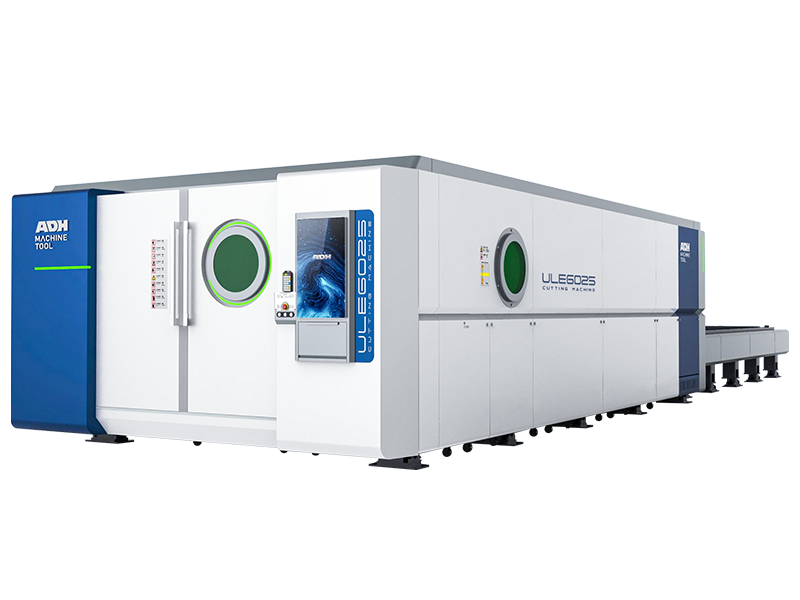
ADH Machine Tool is a professional manufacturer of processing laser cutting machines, that can help you improve production efficiency, optimize design, and enhance aluminum product quality. You can browse our brochures for details or consult our salesmen.
X. FAQs
1. What makes aluminum challenging to cut with lasers?
Aluminum presents challenges in laser cutting primarily due to its high reflectivity, which can scatter the laser beam and potentially damage the equipment, and its excellent thermal conductivity, which dissipates heat quickly and makes localized melting difficult.
Additionally, the oxide layer on aluminum surfaces has a higher melting point, leading to inconsistencies in cut quality. These factors require careful adjustment of laser parameters and the use of assist gases to achieve precise cuts, as discussed earlier.
2. Why is assist gas important in laser cutting aluminum?
Assist gas is crucial in laser cutting aluminum because it helps remove molten material and debris from the cut zone, preventing rough edges or imperfections. It also aids in dissipating heat, reducing thermal distortion, and ensuring accurate cuts. Inert gases like nitrogen prevent oxidation of the cut edges, resulting in a clean, oxide-free finish.
Proper optimization of the assist gas's pressure and flow rate, along with correct nozzle alignment, enhances cutting performance, efficiency, and quality, making it an essential component in the laser cutting process for aluminum.
3. How do I adjust focus position for optimal results?
To adjust the focus position for optimal laser cutting of aluminum, ensure the laser beam is precisely focused on the material's surface to maximize cut quality and precision. Utilize methods like the numerical control positioning method, where the smallest dot indicates the optimal focus, or the inclined focus burning method, identifying the narrowest burn mark.
Adjustments may be necessary based on material thickness and type, laser power, and beam quality. Proper focus minimizes thermal damage and ensures smooth edges, as discussed earlier. For high-volume production, consider using auto-focusing for consistency.










 English
  العربية
  বাংলা
বাংলা  Български
  Čeština
  Dansk
Dansk  Nederlands
  Deutsch
  Suomi
Suomi  Français
  Ελληνικά
  עִבְרִית
  हिन्दी
  Magyar
  Bahasa Indonesia
  Italiano
  日本語
日本語  Қазақ тілі
  한국어
한국어  Bahasa Melayu
  Norsk bokmål
  فارسی
فارسی  Polski
  Português
  Português do Brasil
  Română
  Русский
  Српски језик
  Slovenčina
  Español de México
  Español
  Svenska
  Kiswahili
  தமிழ்
தமிழ்  Türkçe
  ไทย
ไทย  Tagalog
  Українська
  Tiếng Việt
  اردو
اردو  简体中文
简体中文  香港中文
香港中文  繁體中文
繁體中文