
When asking "Are NC machines faster than conventional machines?" the answer is more nuanced than a simple yes or no. This article redefines what "fast" truly means, moving beyond mere cutting speed to embrace the total production cycle—from initial setup to mass production.
It starts with a direct answer: production volume and part complexity decide the winner, with single-piece and simpler jobs having different dynamics. We then decode the four core accelerators of NC machines—automation, precision, repeatability, and skill leverage—that fuel their advantages.
Simultaneously, we explore the efficiency traps where conventional machines can outperform, such as high setup times and programming overhead. Finally, the article offers a four-step evaluation method and a weighted decision matrix, providing a clear, actionable framework to select the optimal equipment based on speed, cost, and complexity.
This comprehensive guide paves the way for smarter, faster, and more cost-effective manufacturing decisions.
I. Framing the Question: Redefining “Speed” for Instant Clarity
“Are CNC machines faster than traditional ones?” This question is much like asking, “Which is faster—a jet or a helicopter?” Without context, the answer is meaningless. In the unforgiving arena of manufacturing, speed isn’t a one-dimensional race; it’s a complex trade-off among total cost, total time, and final value. As a decision-maker, your goal isn’t to chase a simple “yes” or “no” answer, but to build a higher-level framework for evaluation.
1.1 The Straight Answer: Batch Size and Complexity Decide the Winner
To save your time, here’s the direct conclusion:
- In large-batch production, complex geometries, and high-precision repetitive operations, CNC machines are the undisputed champions of speed. Their automation, accuracy, and tireless repetition form the foundation of modern manufacturing efficiency.
- However, in single-piece fabrication, quick repairs, or simple prototypes, a conventional machine operated by a skilled machinist can often surpass a CNC machine in turning an idea into a finished part.
In short, batch production and complexity are CNC’s home turf, while one-off work and simplicity are where traditional machines can still pull ahead in real-world speed.
1.2 The Crucial Mindset Shift: From “Cutting Speed” to “Total Production Cycle”
Newcomers to the industry often equate “speed” with spindle rotation or feed rate—an understandable but critical misconception. True efficiency experts focus on the Total Production Cycle—the entire time from receiving a drawing to delivering a finished, compliant part.
Cutting speed is only one small segment of that process. The total production cycle is made up of both value-adding and non–value-adding phases:
- Setup time: includes drawing analysis, process planning, programming, machine setup, workholding, and tool calibration.
- Machining time: the actual material removal process.
- Non-machining time: automatic tool changes, table movements, part reorientation, and similar actions.
- Human intervention time: supervision, measurement, manual adjustments, and dealing with unexpected events.
The revolutionary strength of CNC technology lies precisely in how drastically it reduces non-machining time and human intervention time. While traditional machines might match cutting speed on simple parts, their heavy reliance on manual steps, repeated setups, and operator judgement stretches the overall production cycle dramatically. In batch production, that disadvantage multiplies exponentially.
Thus, our first major mindset shift is this: stop thinking tactically in terms of “cutting speed” and start strategizing around the “total production cycle.” True speed comes from end-to-end optimization—not just pushing one phase to its limit.
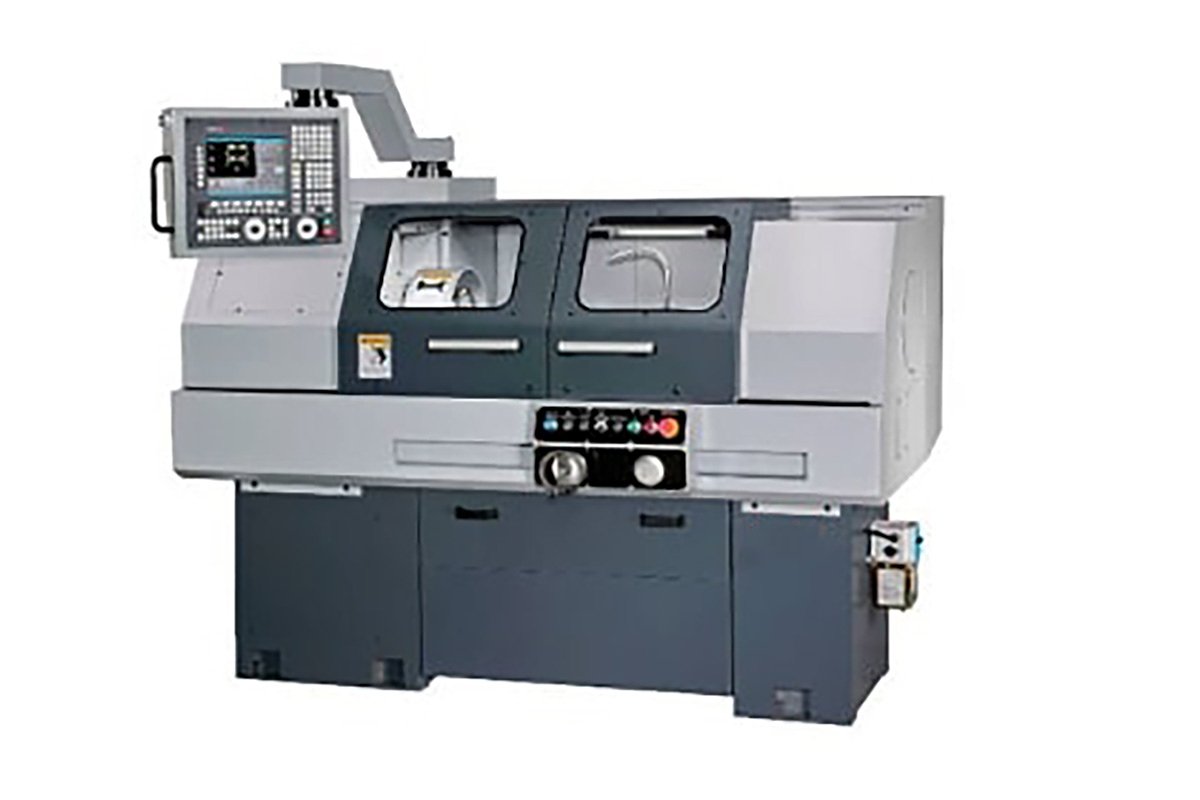
1.3 The Quick Decision Matrix: One Chart to Reveal Your Best Choice
To turn the above principles into a practical decision tool, use the following matrix to identify your optimal approach:
| Decision Dimension | CNC Machine | Conventional Machine | Conclusion: Which Is Faster? |
|---|---|---|---|
| Production Volume | Overwhelming advantage. One-time programming enables infinite replication with constant rhythm and near-zero marginal time cost. | Significant disadvantage. Each part requires manual operation, total time scales linearly with quantity, making efficiency unscalable. | CNC machine (the larger the batch, the greater the exponential advantage). |
| Part Complexity | Built for complexity. Handles multi-axis motion, curved surfaces, and intricate cavities with precision replication of design intent. | Limited capability. Relies heavily on operator skill and complex fixtures; many geometries are impractical or inefficient to produce. | CNC machine (higher complexity amplifies its automation advantage). |
| First-Part Speed | Longer preparation. Requires programming, simulation, and tuning, which may take hours or even days for complex parts. | Quick start. Skilled machinists can begin cutting within minutes for simple parts. | Conventional machine (fastest only for simple, non-repetitive tasks). |
| Repeatability | Near perfect. The program ensures identical paths and parameters, resulting in exceptional consistency. | Dependent on operator control. Difficult to maintain identical outputs—risk of drift and cumulative errors. | CNC machine (its hidden speed comes from reduced scrap and rework). |
| Skill Requirements | Skill redefined. Focus shifts to programming and process understanding rather than years of manual feel and muscle memory. | Highly dependent on craft. Mastery takes years, and output quality can vary with operator condition. | CNC machine (organizational acceleration by reducing reliance on top-tier experts). |
| Design Change Flexibility | Extremely high. Modifying a program quickly adapts to design revisions—ideal for iterative product development. | Low. Complex fixture changes take considerable time and cost. | CNC machine (faster for agile development and market responsiveness). |
The conclusion is clear: CNC machines deliver a systemic, repeatable, and scalable speed advantage. By sacrificing immediate response in one-off tasks, they achieve unmatched total-cycle efficiency in large-scale, high-complexity, high-precision production. Traditional machines, in contrast, offer individual, immediate, and flexible speed, still valuable for short, simple, or emergency jobs.
II. Decoding Speed: The Four Core Accelerators of CNC Technology
If the first section reshaped how we define “speed,” this section dissects the inner workings of CNC machines—the four engines driving their breakthrough productivity. The CNC’s speed advantage doesn’t come from brute-force acceleration in one area, but from a systemic, data-driven revolution in manufacturing logic. Through four core accelerators, CNC technology fundamentally redefines the relationship between time and value.
2.1 Automation Supremacy: Drastically Compressing Non-Cutting Time
In traditional thinking, the roar of a machine symbolizes productivity. But the hard truth is that actual cutting time accounts for only a fraction of the entire cycle. The real efficiency killer is non-cutting time—the “time black hole” covering setup, manual tool changes, measurements, and idle transitions between steps. In some complex scenarios, these auxiliary activities can consume over 60% of the total production cycle.
The automation capabilities of CNC machines are designed to wage a full-scale battle against this wasted time.
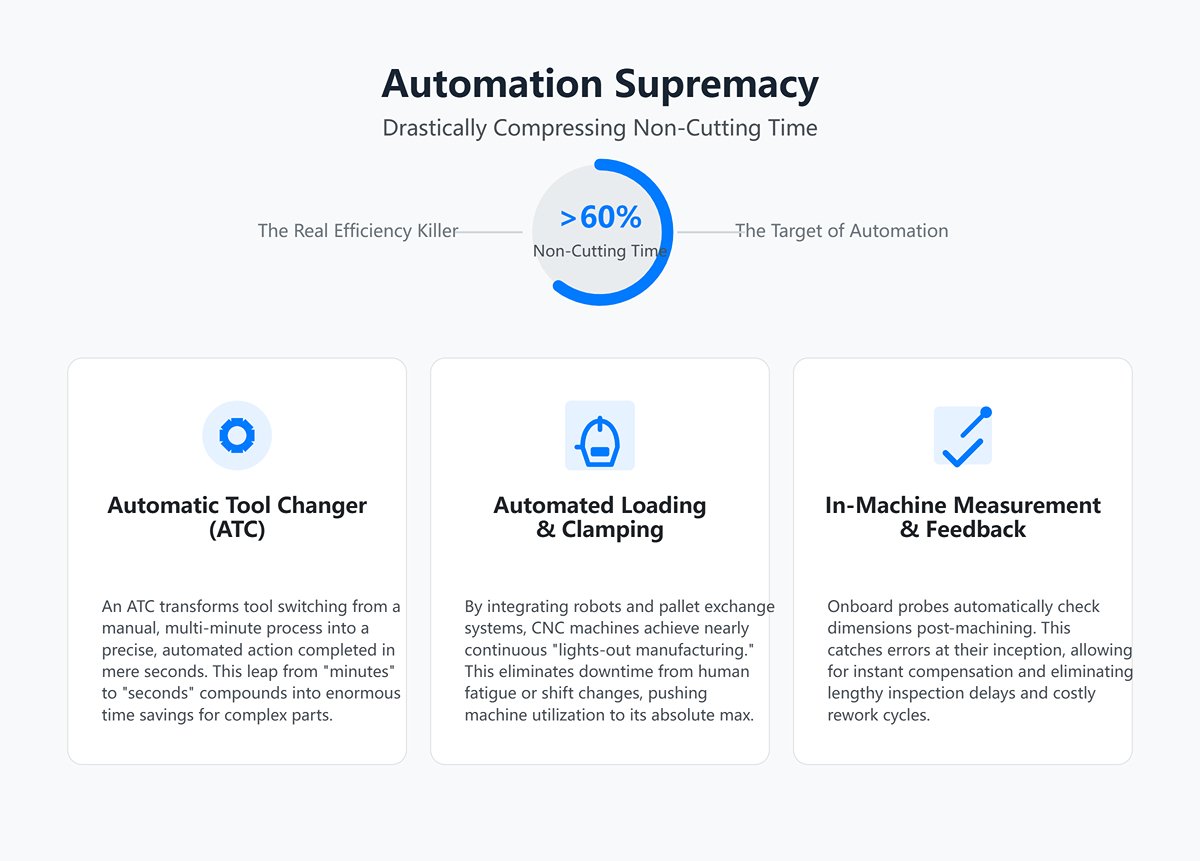
- Automatic Tool Changer (ATC): Imagine a scenario where a single part requires ten different tools. On a traditional machine, that means ten stoppages, ten manual tool changes, and ten recalibrations—costing upward of half an hour. A CNC machining center equipped with an automatic tool changer, however, can switch tools precisely within seconds at the command of a programmed instruction. This leap from "minutes" to "seconds" compounds into enormous time savings when processing multi-stage components.
- Automated Loading and Clamping: By integrating robots, pallet exchange systems (APC), and other automation modules, CNC machines enable nearly continuous "lights-out manufacturing." Robots handle loading and unloading with precision and tireless consistency, eliminating downtime caused by human fatigue or shift changes and pushing machine utilization rates to their maximum.
- In-Machine Measurement and Feedback: Traditional workflows follow a sequence of “processing–inspection–waiting–rework.” With onboard measurement probes, CNC machines can automatically check critical dimensions either between operations or immediately after machining. If deviations are detected, the system can instantly compensate or raise an alarm, catching errors at their inception and eliminating lengthy inspection delays and costly rework cycles.
Essentially, automation enables CNC machines to integrate what was once a collection of manual, fragmented, time-consuming, and error-prone steps into a seamless, efficient, and predictable process. This dramatically compresses "non-cutting time," allowing machines to devote more of their lifecycles to genuine value creation.
2.2 Conquering Complexity: Turning the “Impossible” into Efficient Reality
For simple planes or cylinders, the pure cutting time difference between conventional and CNC machines might be minimal. However, as part geometries grow more complex, their performance diverges sharply. Complexity—a barrier of efficiency in traditional machining—becomes fertile ground for CNC technology to excel.
- Multi-Axis Coordination and One-Step Completion: Take an aircraft impeller or an orthopedic implant, for instance. Their intricate freeform surfaces and deep cavities require multiple—sometimes more than ten—reclampings and re-alignments on a conventional three-axis machine to complete. Each reclamping wastes time and introduces cumulative errors. A five-axis CNC machine, however, allows the tool to approach the part from virtually any angle and complete all complex features in a single setup. It condenses multi-day, multi-operation workflows into a single automated procedure lasting only a few hours.
- Programmatic Control That Defies Geometric Complexity: Humans excel at guiding tools along straight lines and simple curves, but struggle with complex mathematical surfaces like Non-Uniform Rational B-Splines (NURBS). The essence of CNC technology lies in translating these intricate geometries through computer-aided manufacturing (CAM) software into machine-readable G-codes that the system can execute precisely. To the CNC controller, machining a twisted blade or a simple block is conceptually identical.
Thus, CNC machines transform “complexity” from an obstacle that grows exponentially with time cost into an engineering problem solvable through programming and advanced hardware. In the realm of complex parts, the “speed” of CNC lies in its ability to turn what once seemed impossible into tasks completed efficiently in one go.
2.3 Ultimate Repeatability: The “Invisible” Speed Gain from Stable Quality
The true bottleneck in production speed often isn’t the machining itself—it’s rework and scrap. A component scrapped due to dimensional errors nullifies all invested time, materials, and energy, effectively cutting efficiency in half. The exceptional repeatability of CNC machines is their most powerful “invisible accelerator.”
Repeatability refers to a machine’s ability to return precisely to the same position when executing identical instructions repeatedly. This means:
- Highly Predictable Processes: Once the first piece has been successfully tuned, hundreds or even thousands of subsequent items can be produced in exactly the same way. This program-locked consistency eliminates defects caused by operator fatigue, mood variations, or differences in experience, reducing the scrap rate to a minimum.
- Shifting from Full Inspection to Sampling: When production stability reaches a high level, quality control can transition from exhaustive, time-consuming “inspection of every piece” to scientifically managed periodic sampling. This not only liberates significant manpower and time but also reinforces confidence in the entire production system.
- The Foundation of Unmanned Operation: This high predictability empowers companies to let equipment worth millions operate unattended overnight or through weekends—an extreme utilization of time unimaginable for manual machines.
Ultimately, CNC machines, through unmatched repeatability, guarantee stable, high-quality output. This consistency prevents the most expensive forms of waste—lost time and material—delivering exponential gains in overall production efficiency. Stable quality itself is the highest form of speed.
2.4 Skill Leverage: Unlocking the Productivity of Human Expertise

A common misconception is that automation devalues human skill. In advanced manufacturing, the reality is quite the opposite: CNC technology acts as a force multiplier for top-tier expertise.
- Skill Front-Loading and Reuse: Under traditional methods, a master technician’s craftsmanship and experience are confined to an individual—applicable to one machine and one workpiece at a time. In CNC manufacturing, critical expertise is front-loaded into process planning and programming. A skilled process engineer can encode deep understanding of material properties, tool selection, and cutting strategy into an optimized program. This program becomes a digital embodiment of that master’s intelligence—capable of flawless, tireless execution by any qualified operator, infinitely repeatable.
- Exponential Growth in Productivity: In traditional workshops, it’s one worker per machine. In a highly automated CNC environment, one skilled technician can monitor and oversee three to five machines—or even more—at once. Their role shifts from repetitive laborer to system manager, optimizer, and problem-solver. The per-capita output thus multiplies severalfold, sometimes by an order of magnitude.
- Knowledge Inheritance and Evolution: Superior machining programs and process parameters can be stored, shared, and continuously refined, becoming part of a company’s core digital assets. New employees can quickly reach proficiency through standardized programs, drastically shortening the training curve.
In the end, CNC technology hasn’t made craftsmanship obsolete—it has elevated it from an art of "touch" to a science of "logic." It enables the large-scale replication and evolution of manufacturing intelligence, unlocking unprecedented productivity and accelerating efficiency across the entire organization.
III. Efficiency Traps: How Traditional Machines Sometimes Stage a Surprising Comeback
While we celebrate the automation and precision that CNC technology delivers, an invisible force—its inherent complexity—quietly exerts its pull. Under certain conditions, this gravitational force can turn into an “efficiency trap,” ensnaring decision-makers who chase speed at all costs.
In these moments, the seemingly “obsolete” traditional machine tool reclaims the spotlight. Through remarkable simplicity and flexibility, it executes a stunning comeback. It reminds us that the most efficient tool is always the one that fits the task perfectly.
3.1 The Burden of Startup Costs: The Time Barrier of Programming and Debugging

The total efficiency of a CNC machine follows a straightforward formula: Total Time = Setup Time + (Cycle Time per Part × Quantity). The machine’s glory lies in its lightning-fast cycle time—but its pain point hides in the setup phase. Before it can carve the first chip, the CNC machine must shoulder a significant startup cost.
This cost list is far longer than most expect:
- Process analysis and programming: Translating 2D drawings or 3D models into machinable G-code—a creative act that fuses engineering expertise with software craftsmanship.
- Program simulation and verification: Virtually test every toolpath to avoid expensive real-world collisions. It’s both insurance and a time investment.
- Fixture preparation: Design, manufacture, or select custom fixtures for nonstandard parts, ensuring complete stability during machining.
- Machine setup: Tool installation, length calibration, and work coordinate configuration—each step demands precision and care.
In prototyping, mold repair, or small-batch customization, these startup activities can consume 80–90% of total working time. That means even the fastest CNC powerhouse can be outperformed by a manual machine if it spends most of its life “warming up” or “waiting.”
A seasoned machinist may well finish a part—using little more than a handwheel and dial gauge—while the CNC programmer is still wrestling with CAM parameters.
3.2 The One-Off Curse: When Programming Time Devours All Machining Advantages
This leads us to a classic manufacturing threshold question: At what production volume does the CNC’s preparation time completely erase its cutting-speed advantage?
The answer points to a sobering figure: “1.” When the task involves making a single, unique part, the “one-off curse” strikes in full force.
Consider a real-world example: a factory must urgently repair a simple locating pin on a piece of equipment.
- CNC path: The process engineer spends 30 minutes creating CAM code and generating toolpaths; the operator spends another 30 minutes setting up the machine, touching off tools, and performing a test cut. Even if machining takes only 5 minutes, total elapsed time exceeds an hour.
- Manual path: A veteran machinist receives the drawing and raw stock, marks the material directly, and—guided by decades of experience—delivers a fully qualified part within 15–20 minutes.
In this showdown, the manual machine wins decisively. Its edge lies in zero programming overhead. For “high-mix, low-volume” production—common in repair, R&D prototyping, and artistic fabrication—the manual machine’s agility and immediacy deliver strategic value that CNC systems simply cannot match.
3.3 The Skill-Curve Challenge: Bridging the Gap from Machinist to Programmer
The CNC revolution is not just a technological shift—it represents a fundamental transformation in the skills paradigm. Traditional manufacturing relies heavily on tacit knowledge—muscle memory and intuitive judgment refined through years of hands-on practice. CNC machining, on the other hand, is rooted in explicit knowledge—codified, quantifiable expertise in programming and process planning that can be stored, replicated, and transferred.
This transformation introduces new efficiency barriers:
- A steep learning curve: Mastering CNC technology takes time. It demands not just an understanding of machining theory, but also proficiency in engineering drawing, CAM software, and G-code debugging. The learning effort far exceeds that required to operate a conventional lathe or mill.
- Shortage of hybrid experts: In real-world workshops, professionals fluent in both traditional craftsmanship and modern CNC programming are extremely rare. As a result, responsive and skilled CNC programmers often become critical bottlenecks in the production process.
Therefore, if a company has a team of highly skilled traditional machinists but lacks agile programmers, it is often more efficient to let the veterans take direct action—especially for short, simple, or urgent tasks—rather than waiting for code to be written for an idle, expensive CNC machine.
3.4 Cognitive Load: Programming’s Mental Strain vs. the Intuition of Manual Work
There is a human factor often omitted from engineering analyses, yet it profoundly influences efficiency: cognitive load, or the amount of mental effort required to perform a task.
- High cognitive load in CNC programming: Writing or debugging code is an intensely intellectual endeavor. The programmer must visualize 3D geometries, plan tool movements, calculate cutting parameters, and foresee every possible interference. This constant mental juggling imposes significant psychological strain and fatigue. Studies show that under high cognitive load, completion time can increase by nearly 50%, with error rates rising in parallel.
- Intuitive feedback in manual operation: For an experienced machinist, manual work approaches a “flow” state. He senses vibration, listens to cutting tones, even interprets chip color and shape as real-time feedback. Decisions and actions occur almost simultaneously. This direct sensory loop keeps cognitive load relatively low.
In situations where speed is critical—say, adding a chamfer or drilling a simple hole to an existing part—manual machining’s immediacy bypasses the entire “model–program–simulate–verify” cycle. Paradoxically, CNC systems’ intelligence can sometimes become a cognitive constraint, while the manual machine’s raw simplicity becomes a shortcut to productivity.
IV. The Four-Step Evaluation Method: Choosing the Most Efficient Machine for Your Task
This method transforms your decision-making process from an intuition-based “art” into a data-driven “science.” Follow these four steps to identify the best-fit machining solution for every task.
Step 1: Define Your Core Constraints
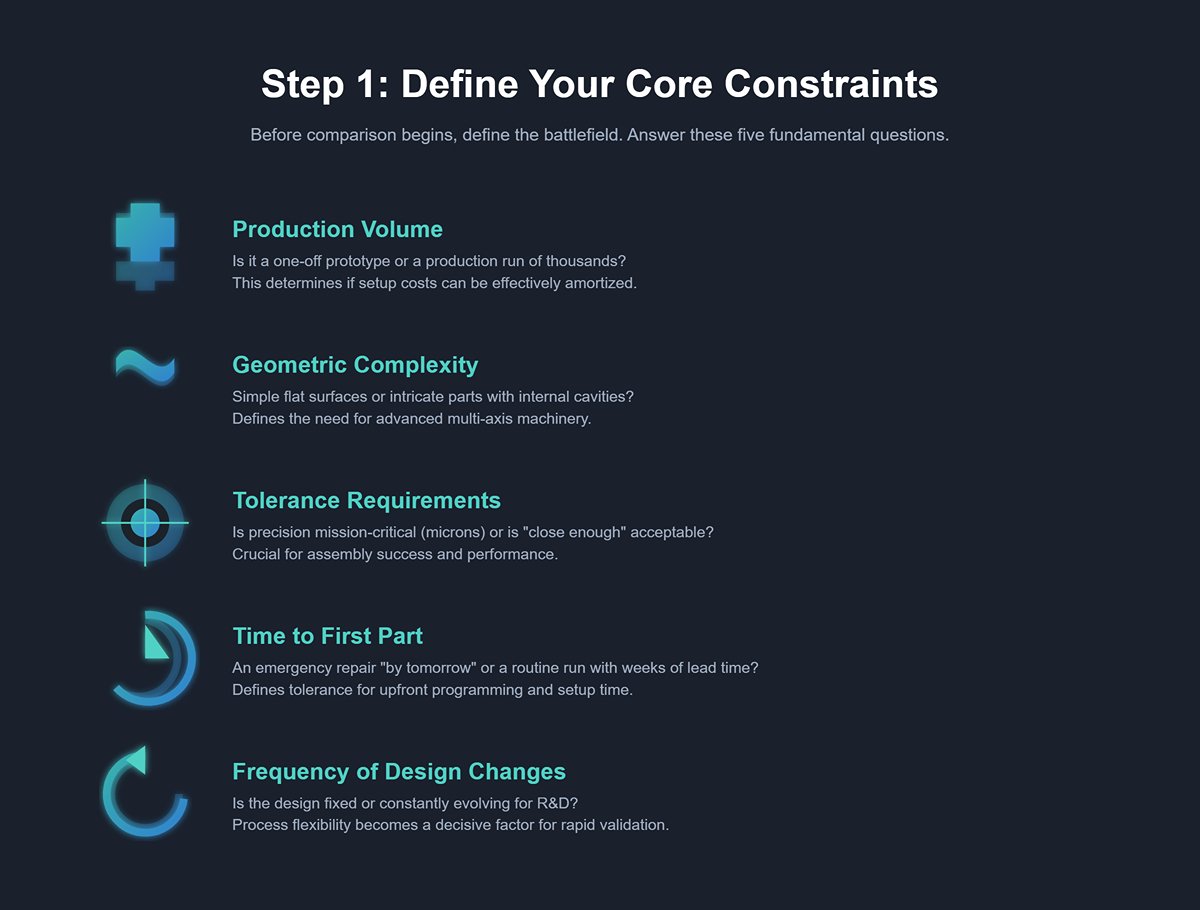
Before any comparison begins, you must first define the battlefield. Different terrains call for different troops. Challenge your project by answering these five fundamental questions clearly:
- Production Volume: Where does the balance tip for your task? Is it a one-off prototype—or a production run repeated thousands of times? This is the primary factor that determines whether your setup costs can be effectively amortized.
- Geometric Complexity: Is the soul of your part simple or intricate? Are we talking about flat surfaces and basic hole systems—or freeform curves and complicated internal cavities that demand multi-axis synchronization to sculpt?
- Tolerance Requirements: Is precision mission-critical, or is “close enough” acceptable? Are you working with ±0.1 mm structural parts, or micron-level components where assembly success hangs in the balance?
- Time to First Part: How urgent is your project’s heartbeat? Is it an emergency repair needed “by tomorrow,” or a routine production run with several weeks of lead time? This defines whether you can afford the upfront time investment in CNC programming and debugging.
- Frequency of Design Changes: Is your design fixed or constantly evolving? For R&D projects requiring rapid revision and validation, the flexibility of your manufacturing process becomes a decisive factor.
Step 2: Analyze Total Cost
Move beyond the “unit price” mindset and adopt a “total lifecycle cost” perspective. The real cost encompasses every expense from receiving the drawing to delivering compliant parts.
NC/CNC Machine:
- Upfront Costs (High): These include CAM programming, simulation, and first-setup calibration—substantial intellectual and time investments that shouldn’t be underestimated for complex components.
- Unit Costs (Low in Mass Production): Once automation kicks in, minimal human intervention and stable machining cycles drive the marginal cost per part—especially labor—sharply downward.
- Hidden Costs: Acquisition, maintenance, and specialized personnel training contribute to a higher overall ownership cost.
Conventional Machine:
- Upfront Costs (Very Low): No programming required; preparation mostly involves reading drawings, marking up, and basic clamping—essentially “ready to start” with minimal delay.
- Unit Costs (Relatively Constant and High): Each part demands full hands-on attention from a skilled operator. Their time and expertise are fully embedded in every piece, making the total cost rise linearly with quantity.
- Hidden Costs: Heavy reliance on top-tier machinists increases variability and potential losses from scrap or rework.
Key Insight: Identifying the Break-Even Point. Picture two cost curves: the conventional machine rises steadily from a low base, while the CNC machine starts higher but flattens out more rapidly. Their intersection is your break-even volume. When expected output far exceeds that point, the economies of scale inherent to CNC machining take full effect.
Step 3: Evaluate Total Cycle Time
This directly connects to the core argument: assessing the total lead time from concept to fully finished product.
NC/CNC Machine:
- First-Part Time (Longer): Programming and setup are the main time bottlenecks.
- Total Time for Series Production (Short): Automation ensures high efficiency and uninterrupted throughput—especially in unattended runs, where the time advantage grows exponentially.
Conventional Machine:
- First-Part Time (Very Fast): For simple tasks, nothing matches its near-instant responsiveness.
- Total Time for Series Production (Long): Processing time scales directly with quantity—no automation leverage available.
Key Insight: Are you aiming for rapid responsiveness or large-scale delivery efficiency? The former plays to the tactical strength of conventional machines, the latter to the strategic power of CNC systems.
Step 4: Build Your Weighted Decision Matrix
Now, translate the qualitative insights from the first three steps into a clear quantitative framework. By assigning weights to each criterion, this matrix helps you move past intuition and reach a more balanced, data-driven decision.
How to Apply:
- List the Criteria: Use the core constraints from Step 1 along with additional factors such as quality consistency.
- Assign Weights: Allocate percentage weights (summing to 100%) based on your project’s priorities.
- Score Objectively: Rate both manufacturing methods on each criterion (suggested scale: 1–10).
- Calculate Weighted Scores: Multiply each score by its weight and sum across all criteria to determine the final total.
Scenario 1: Emergency Repair of a Simple Drive Shaft (Batch = 1, Delivery Time = Extremely Short)
| Evaluation Criteria | Weight (A) | CNC Machine Score (B) | Weighted Score (A×B) | Conventional Machine Score (C) | Weighted Score (A×C) |
|---|---|---|---|---|---|
| Time to First Part | 50% | 2 | 1.0 | 10 | 5.0 |
| Upfront Total Cost | 30% | 3 | 0.9 | 9 | 2.7 |
| Geometric Complexity | 10% | 8 | 0.8 | 6 | 0.6 |
| Quality Consistency | 10% | 9 | 0.9 | 6 | 0.6 |
| Total | 100% | 3.6 | 8.9 |
Conclusion: In this scenario, the conventional machine dominates due to its unmatched speed of delivery and minimal setup costs—winning by a decisive margin.
Scenario 2: Mass Production of 500 Complex Medical Device Housings (Batch = 500, High Tolerance)
| Evaluation Criteria | Weight (A) | CNC Machine Score (B) | Weighted Score (AB) | Conventional Machine Score (C) | Weighted Score (AC) |
|---|---|---|---|---|---|
| Unit Production Cost/Time | 35% | 9 | 3.15 | 3 | 1.05 |
| Quality Consistency/Repeatability | 30% | 10 | 3.0 | 4 | 1.2 |
| Geometric Complexity Handling | 25% | 10 | 2.5 | 3 | 0.75 |
| First-Part Lead Time | 10% | 5 | 0.5 | 8 | 0.8 |
| Total | 100% | 9.15 | 3.8 |
Conclusion: In the arena of large-scale, high-complexity production, CNC machines stand as the clear winner. Their combined advantages in cost efficiency, quality control, and capacity to handle intricate designs make them the unquestionable choice.
This decision matrix is not a rigid calculator but a strategic mirror reflecting your real operational needs. By adjusting the weighting factors, you can tailor a unique evaluation model for any specific manufacturing challenge—ensuring that every equipment decision precisely serves your overarching business objectives.
V. Conclusion
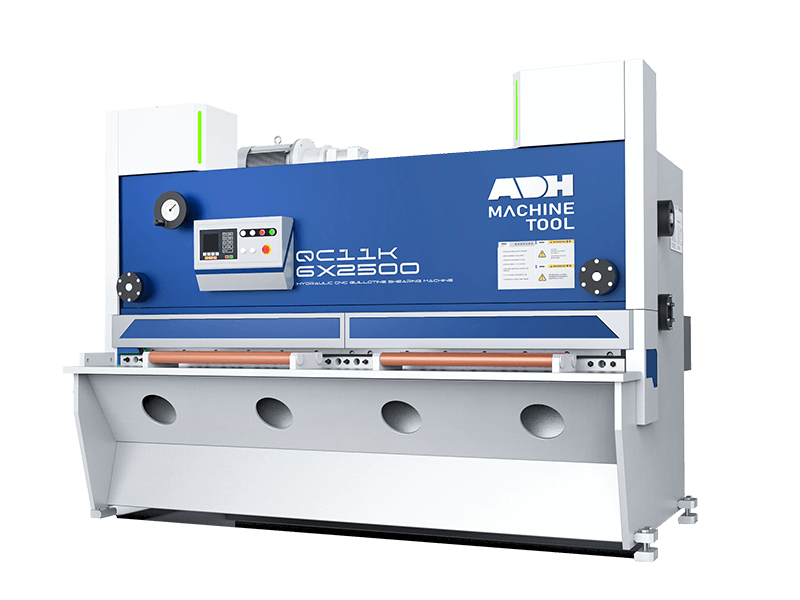
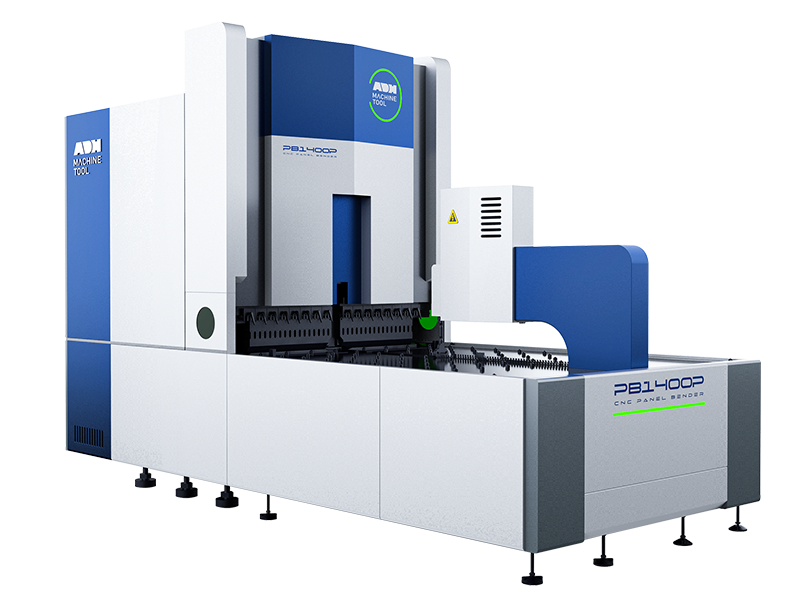
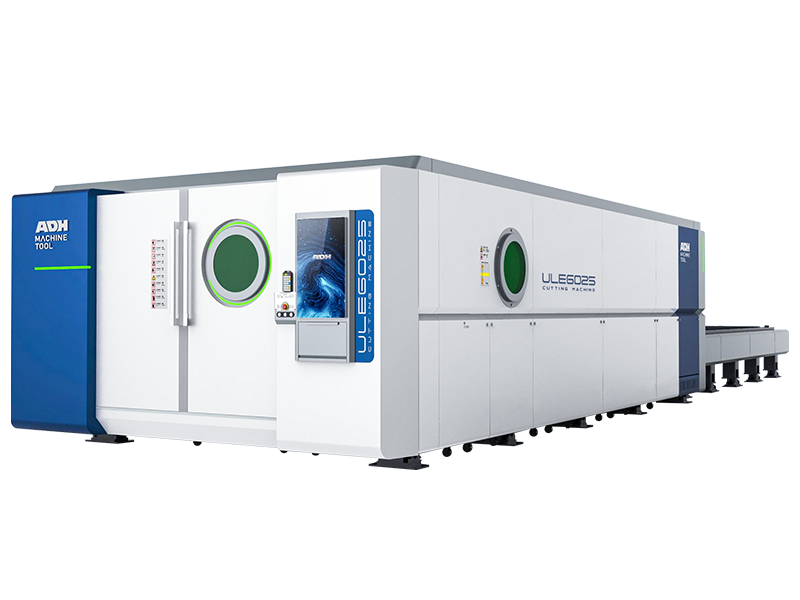
We started with a simple question—“Is a CNC machine faster than a conventional one?”—but uncovered deeper insights. There is no absolute “king of speed” in manufacturing; instead, the best solution depends on the specific task, volume, and cost, a principle you can see reflected in the diverse machinery detailed in our Brochures.
Moving beyond just cutting speed, we considered the total production cycle. CNC machines gain advantages through automation, precision, repeatability, and skilled operation, especially in mass production. However, they also face efficiency challenges like setup costs and single-part inefficiency, where conventional machines remain valuable for quick, agile responses.
Using a Four-Step Evaluation Method and Weighted Decision Matrix, we developed a data-driven framework that shows true speed lies in business precision, knowing when to use CNC or manual methods for smarter manufacturing. If you need assistance applying this framework to find your ideal solution, please contact us.













 English
  العربية
  বাংলা
বাংলা  Български
  Čeština
  Dansk
Dansk  Nederlands
  Deutsch
  Suomi
Suomi  Français
  Ελληνικά
  עִבְרִית
  हिन्दी
  Magyar
  Bahasa Indonesia
  Italiano
  日本語
日本語  Қазақ тілі
  한국어
한국어  Bahasa Melayu
  Norsk bokmål
  فارسی
فارسی  Polski
  Português
  Português do Brasil
  Română
  Русский
  Српски језик
  Slovenčina
  Español de México
  Español
  Svenska
  Kiswahili
  தமிழ்
தமிழ்  Türkçe
  ไทย
ไทย  Tagalog
  Українська
  Tiếng Việt
  اردو
اردو  简体中文
简体中文  香港中文
香港中文  繁體中文
繁體中文