
Hello everyone!
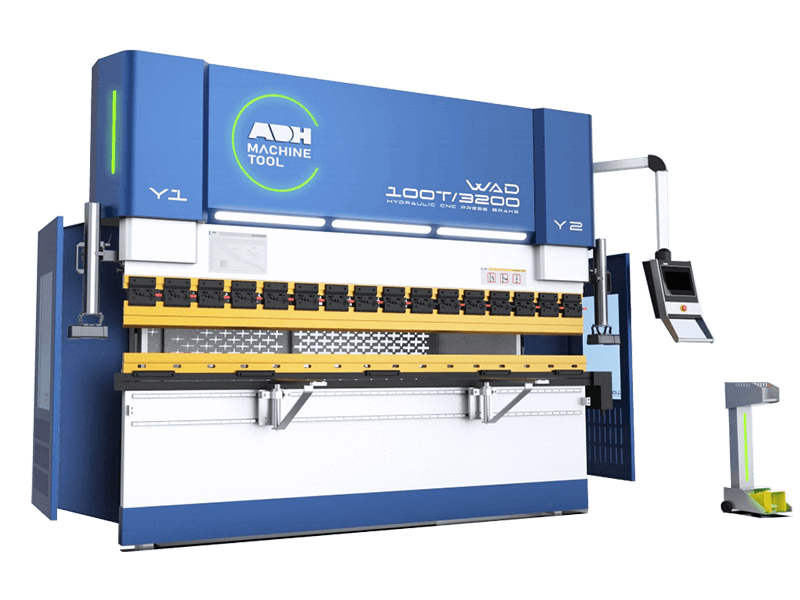
During normal use of the press brake, we often encounter situations where the bending angle in the middle is insufficient under normal circumstances. This is because the deflection compensation motor of the press brake has not been properly adjusted. To understand this process more deeply, you can explore detailed guides on how to adjust the middle bending angle of the press brake provided by ADH Machine Tool.
So how do we increase the deflection compensation? Let’s operate it in the system. This is our control system. As you can see, there is a correction parameter. This correction parameter is the calibration value for mechanical compensation.
It represents the upward convex value in the middle. Based on different sheet lengths, the system automatically calculates a correction value. For example, if it’s currently set to 0, the corresponding bending length is 100 mm.
If we want to bend 3200 mm, a correction value of 7 will be obtained. Press the Run key, and you can see that the actual value has reached the programmed value. The programmed value is automatically calculated. You can also download the latest brochures from ADH to get more parameter references and machine data for your specific model.
If we bend a 3200 mm long sheet, the resulting angle in the middle may be 91°, which is 1° too large
This value needs to be corrected. How do we correct it? Check here under the angle setting.
When the angle is 90°, the corresponding Y-axis depth is 156.41 mm, If we input 91°, the target position for the Y-axis becomes 156.33 mm. That means for every 1° change in angle, the Y-axis depth changes by 0.08 mm.
So we need to increase the correction by 0.08 mm which equals eight threads of correction. If you’re troubleshooting similar calibration variations, refer to this guide on how to adjust the middle bending angle of the press brake for additional insights.
Enter 7, then enter 15, and press the Run key again. At this point, the correction value will move to our modified target position of 15. Next time we perform the bending, the middle depth will increase.
As a result, the angle will become smaller, returning to 90°. Next, let’s look at the workbench of the press brake. When the compensation motor rotates, the entire workbench performs a linear upward convex movement.
If it moves from 7 to 15, it means the convex amount increases from 0.07 mm to 0.15 mm. This way, the bending angle in the middle will be corrected to a smaller value. Conversely, if the middle bending angle is too small, it means the compensation value is too large, so it needs to be reduced.
When reduced, the workbench will move downward. The smallest position forms a straight line. When the workbench is at position 0, it is a parallel line. When we input a correction value, it becomes convex upward.
After the convex adjustment, if the angle is still insufficient, increase the correction value and it will rise further. Conversely, if the middle bending angle is too small, it indicates the compensation value is too large, so it should be reduced.
After reducing it, the middle angle will increase. The workbench has a linear convex and leveling motion. Because there is rebound in the middle, a convex curvature is required to correct the angle.
For more advanced calibration methods and precision improvements, see the detailed technical article on how to adjust the middle bending angle of the press brake. If you have any questions about your machine setup or need personalized assistance, feel free to contact us at ADH Machine Tool.













 English
  العربية
  বাংলা
বাংলা  Български
  Čeština
  Dansk
Dansk  Nederlands
  Deutsch
  Suomi
Suomi  Français
  Ελληνικά
  עִבְרִית
  हिन्दी
  Magyar
  Bahasa Indonesia
  Italiano
  日本語
日本語  Қазақ тілі
  한국어
한국어  Bahasa Melayu
  Norsk bokmål
  فارسی
فارسی  Polski
  Português
  Português do Brasil
  Română
  Русский
  Српски језик
  Slovenčina
  Español de México
  Español
  Svenska
  Kiswahili
  தமிழ்
தமிழ்  Türkçe
  ไทย
ไทย  Tagalog
  Українська
  Tiếng Việt
  اردو
اردو  简体中文
简体中文  香港中文
香港中文  繁體中文
繁體中文