
I. Decision-Making Background: From “Technical Superiority” to “Profit Maximization”
As we step into 2025, continuing to ask whether a hydraulic press brake is more durable than an electric one may already put a company at a disadvantage. For forward-thinking manufacturers, equipment selection is no longer a simple debate over technical routes—it’s a strategic game centered on profit per part and total cost of ownership (TCO).
Once we strip away the marketing jargon, it becomes clear that you’re not just purchasing a machine that bends metal sheets—you’re investing in a productivity solution designed to handle tightening tolerance requirements, rising energy costs, and an increasingly critical talent shortage. For those considering upgrading existing systems, exploring the latest CNC Press Brake lineup can reveal how automation now drives profitability.
1.1 The New Challenges Facing Manufacturing
The era of rough, inefficient production methods is collapsing. Three dimensions of pressure are now reshaping the fundamental logic behind press brake selection:
- The Battle Between Precision Revolution and Cost Pressure When customer tolerance requirements for sheet metal parts leap from the usual ±0.1mm to the ±0.01mm level—as seen in precision electronics enclosures or aerospace components—the physical limits of traditional machines become painfully evident. In hydraulic systems, every 10°C increase in oil temperature alters viscosity and can lead to micron-level “thermal drift” at the slide’s bottom dead center. The result? Angle deviations between morning and afternoon batches. In today’s high material cost environment, such hidden scrap risks directly erode net profit.
- Energy Policy and the Push for Green Manufacturing Electricity costs are no longer a minor line item in the financial report. With global carbon regulations such as the EU’s Carbon Border Adjustment Mechanism (CBAM) taking effect, high-energy-consuming equipment not only drives up operational expenses (OpEx) but can also become a compliance barrier to new orders. Equipment selection must evolve from “as long as it works” to “how much output per kilowatt-hour.” For example, switching to a fully Electric Press Brake can immediately cut energy waste and support sustainability goals.
- Skilled Labor Shortage and Generational Divide The most subtle yet deadly challenge. Younger operators are digital natives—they prefer touchscreens and instant feedback, and they instinctively reject greasy, noisy machines that rely on a veteran’s tactile intuition for pressure adjustment. The next generation of press brakes must offer automated, interactive intelligence to compensate for lost experience, or factories will face the awkward reality of “orders in hand, but no one to run the machines.”
1.2 Redefining Core Concepts
To make the right strategic decisions, we must move beyond textbook definitions and reassess these three technology routes through the lens of manufacturing efficiency:
- Hydraulic Press Brake: The Foundation of Heavy Manufacturing It’s not merely a “machine with brute force.” Built on the principles of continuum fluid dynamics, its core strength lies in extremely high “force density”—delivering thousands of tons of pressure at relatively low cost. It remains dominant for thick plate processing and overload conditions but comes with trade-offs: continuous energy consumption, complex valve maintenance, and temperature sensitivity.
- Electric Press Brake: The Precision Tool of Dynamic Response Designed for much more than energy savings, its essence lies in servo direct-drive technology, enabling millisecond-level dynamic responsiveness. This gives the ram exceptional acceleration and micron-level repeat positioning accuracy. For frequent start-stop small-part processing and complex bends, it acts like a data-driven sprinter—eliminating hydraulic delay and drastically reducing cycle time. For deeper insights, download our detailed brochures to compare performance data across models.
- Hybrid Press Brake: The Third Path Beyond Physical Compromise Not a mere fusion, but a deep integration of fluid power and electronic control. Through dual servo pump control, hybrid press brakes deliver “on-demand hydraulics”—the pump stops when the ram rests, combining the hydraulic system’s high tonnage output with servo efficiency and quiet operation. It strategically balances “force vs. speed” and “cost vs. precision.”
II. What Are Hydraulic Press Brakes?
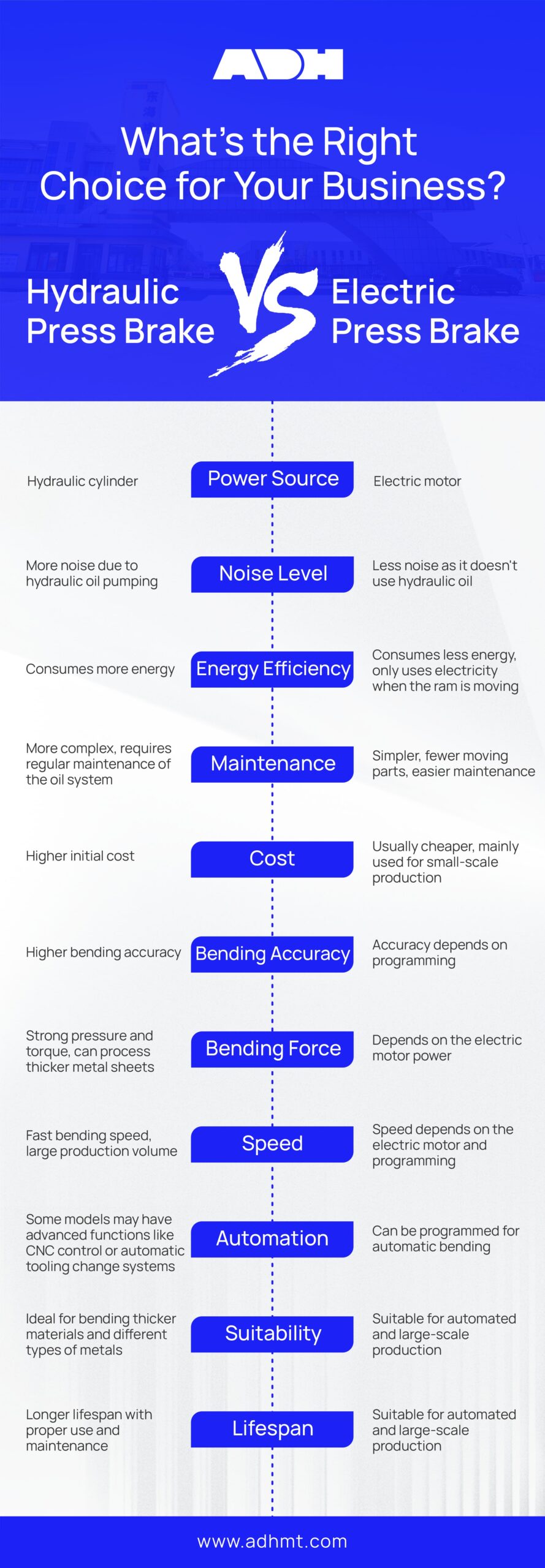
Hydraulic press brakes have been dominant in the field of sheet metal bending since their inception. The power source of the hydraulic press brake is the hydraulic cylinder, which pushes the ram to apply force to the metal plate for bending.
The traditional hydraulic press brake has a hydraulic system where hydraulic oil is pumped into the cylinder to generate force. The pressure generated by the synchronous hydraulic cylinder forces the crossbeam or ram to press down onto the bending metal plate.
The hydraulic system provides high tonnage for hydraulic press brakes, suitable for heavy-duty bending. The hydraulic system can also accurately control the movement of the ram, providing accurate and consistent bending.

The hydraulic press brake machine also includes a mechanical, hydraulic hybrid system and an electric hydraulic system. Each type of hydraulic press brake has its own unique functions and advantages.
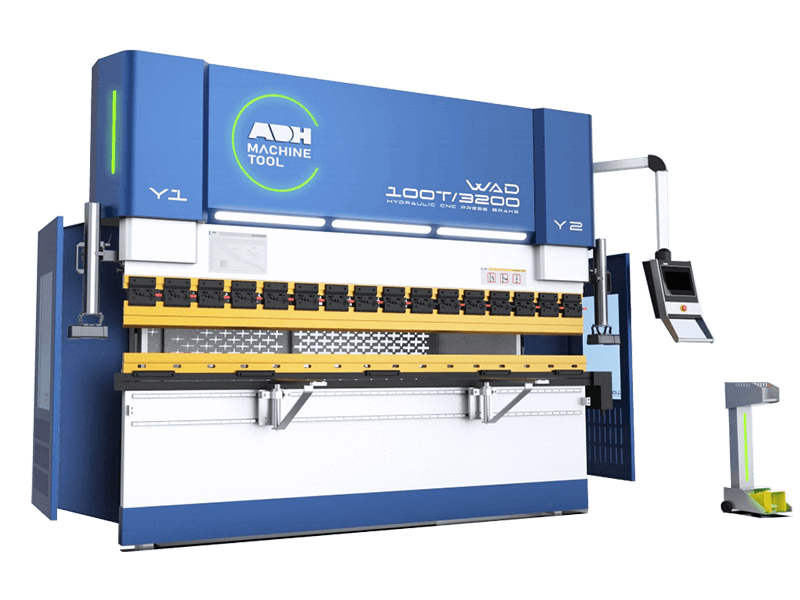
Some hydraulic press brakes may also have more advanced functions, such as CNC control or automatic tooling change systems. The CNC hydraulic press brake has a large tonnage range and is ideal for bending thicker materials.
Moreover, it can also bend different types of metals, from aluminium to stainless steel. The hydraulic press brake is also very durable, and proper use and maintenance can extend its service life.
III. How Does A Hydraulic Press Brake Work?
The hydraulic press brake uses a motor-driven hydraulic pump to transport hydraulic oil to the valve, guiding the pressurized oil to the cylinder. The hydraulic cylinder pushes the ram downward to apply pressure on the metal sheet, causing it to bend into the desired shape.
The operator places the metal sheet on the workbench, and the back gauge needs to clamp the material to prevent it from moving during the bending process. The back gauge can be manually adjusted or automatically adjusted by a CNC controller.
The operator presses the pedal or activates the hydraulic system through the controller. The hydraulic oil is pumped into the cylinder, and the pressure generated causes the ram to apply pressure to the metal plate to achieve bending.
The size of the bending force and the length of the bending can be set according to the required workpiece size. After a bending is completed, the hydraulic system releases pressure, allowing the ram to move back to its original position.
IV. What Are Electric Press Brakes?
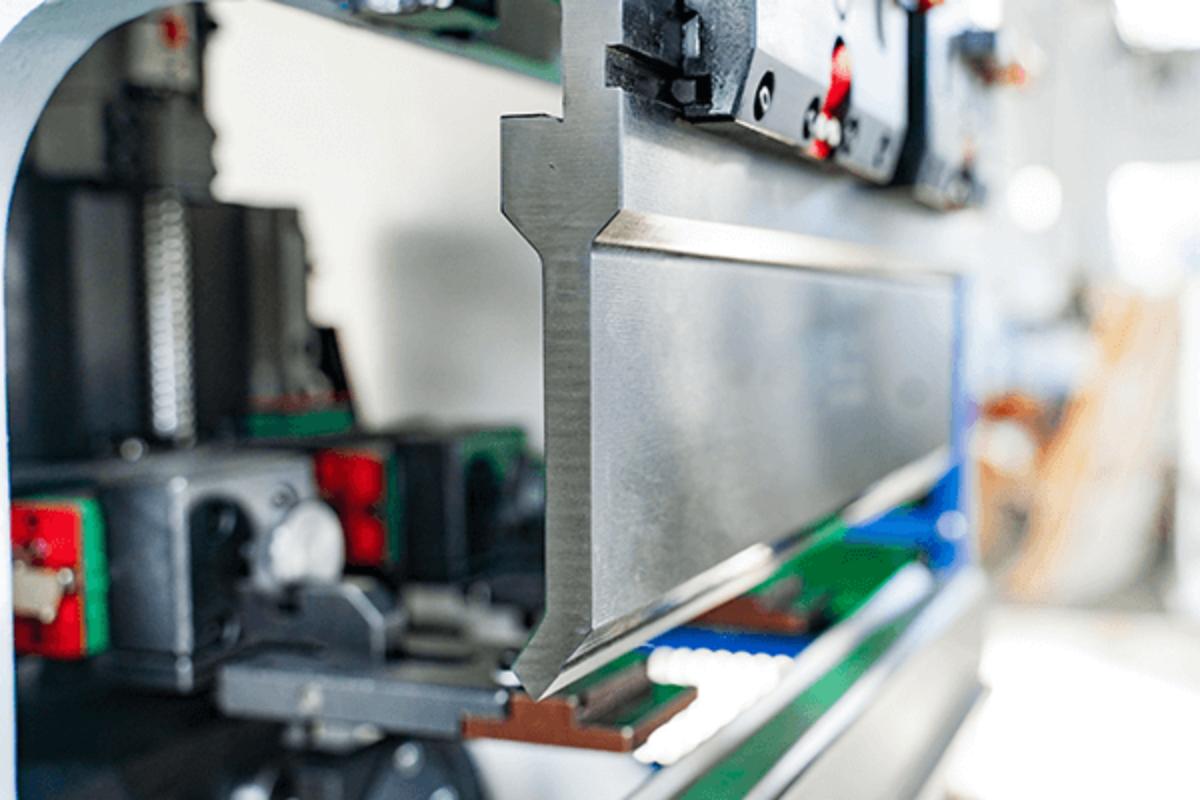
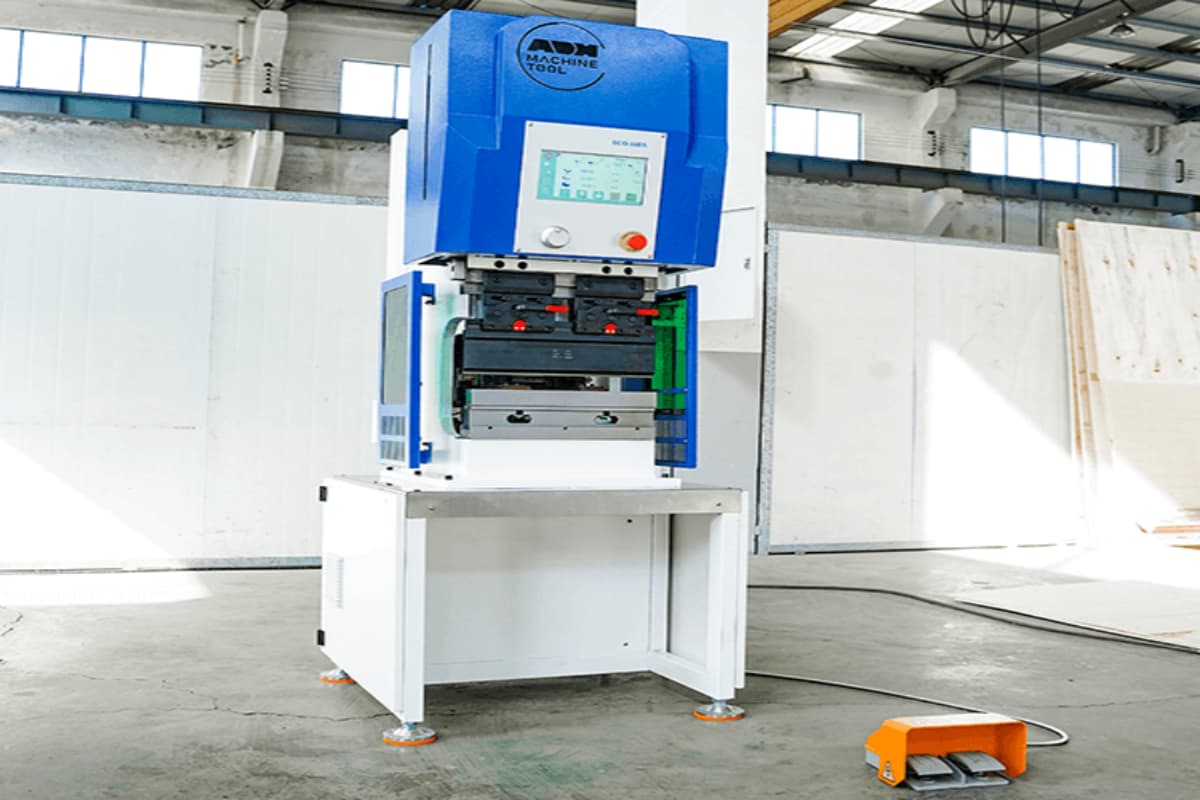
Electric press brakes are also processing machines used for metal bending and forming. Unlike hydraulic press brakes, electric press brakes use electric motors instead of hydraulic oil to provide power to the ram, so there is no pollution problem such as hydraulic oil leakage and waste oil disposal, which is more environmentally friendly.
The electric motor drives the ball screw or belt to move the ram and apply pressure to the metal plate. Electric press brakes offer higher precision than hydraulic press brakes. Through this precise and repetitive bending, a precise workpiece can be completed.

Due to the fact that the electric motor does not use hydraulic oil to generate pressure, it makes less noise when used. And the power of the electric press brake is only consumed when the ram moves, which can save energy consumption.
Taking a 100-ton press brake as an example, assuming an 8-hour workday, the power consumption of a fully servo electric press brake is about 12 kWh/day. In contrast, the power consumption of the hydraulic system in a hydraulic press brake is about 60 kWh/day. The fully electric servo press brake saves about 80% in energy.
The body and structure of the electric press brake are simpler, with fewer components and easier maintenance. The types of electric press brakes include fully electric press brakes and hybrid electric press brakes. The fully electric press brake only uses an electric motor as the power source to push the ram to move.
The hybrid electric press brake may use both an electric motor and a hydraulic system to provide power support. Electric press brakes can be programmed for automatic bending, making them suitable for automated and large-scale production.
Ⅴ. The Ultimate Showdown: A KPI-Based Performance Comparison
This chapter strips away all marketing gloss and dives directly into the hard physics and economics behind performance. We’ll use microseconds (ms), microns (μm), and newtons (N) to quantify your potential profit leakage points.
5.1 Power Transmission and Control Mechanisms: Fluid vs. Electronics
At its core, this contest pits compressible fluid against rigid electronic transmission.
- “Mushy” vs. “Rigid” Response Delays
- Hydraulic (Mushy Effect): Few salespeople admit that hydraulic oil is compressible. Its bulk modulus is around 1.5–2.0 GPa, meaning under high pressure, the fluid behaves like a spring—compressing about 0.5–1% per 100 bar. Combined with servo valve switching delays (typically 50–200ms), this creates an unavoidable physical lag between command and action.
- Electric (Rigid Direct Drive): Electrons travel through wires nearly at the speed of light, and servo control loops respond in less than 1ms. More importantly, the servo motor drives the ram via a ballscrew or belt—a purely mechanical rigid link. With no fluid “spring effect,” commands translate into immediate motion, offering genuine “what you see is what you get” precision.
- Thermal Stability: The Invisible Assassin of Micron Precision
- Hydraulic Systems’ Achilles’ Heel—Thermal Drift: A mere 10°C change in oil temperature alters viscosity, causing internal leakage fluctuations and disrupting bottom dead center (BDC) consistency. Without costly oil chillers, angle deviations between the first and post-lunch batches are a thermodynamic inevitability. Electric systems, aided by servo motors’ closed-loop thermal compensation algorithms, virtually eliminate this variable.
5.2 Measured Accuracy and Repeatability
In precision manufacturing, accuracy isn’t just a number—it’s the key to eliminating costly secondary forming operations.
The Magnitude Gap in Ram Positioning Accuracy
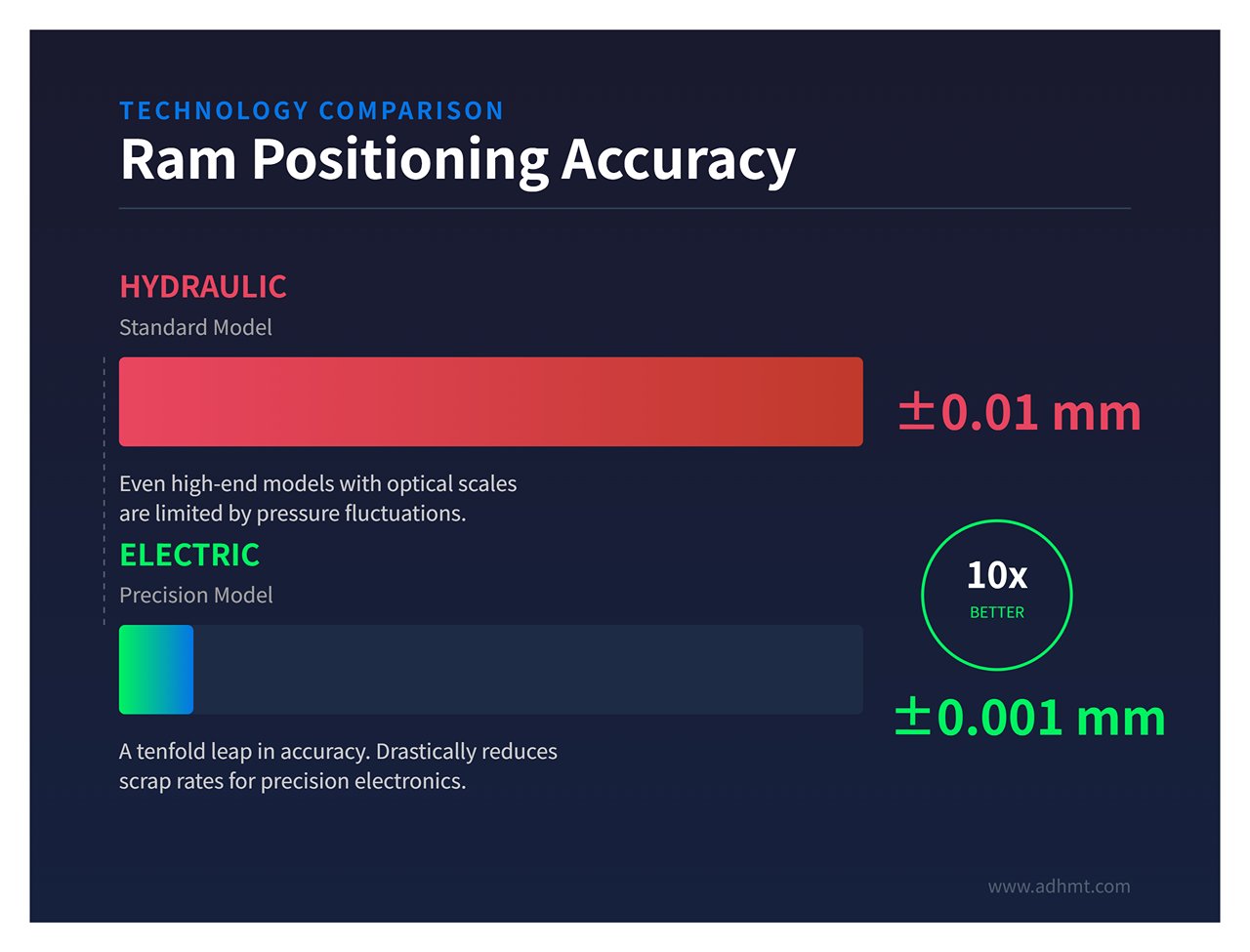
- Hydraulic: Standard models typically maintain ±0.01mm accuracy. Even with high-end versions using optical scales for closed-loop feedback, they remain limited by pressure fluctuations within the cylinders.
- Electric: Standard models achieve ±0.001mm accuracy—a tenfold leap. For precision electronics housings (e.g., server chassis, aircraft instrument panels), this translates into a dramatic drop in scrap rates.
Angle Consistency and the Battle Against Deflection
- Hydraulic pain points: A hydraulic press relies on cylinders applying pressure from both ends, which inevitably causes the ram to bend slightly upward in the middle under load—a phenomenon known as “crowning.” To counteract this, manufacturers must use a complex mechanical crowning system. This not only adds tens of thousands of yuan to equipment costs but also depends heavily on the operator’s experience in adjusting compensation parameters based on sheet thickness.
- Electric precision: Systems such as SafanDarley’s pulley/belt drive mechanism distribute driving force evenly across the entire length of the ram. By design, this eliminates uneven stress, reducing the need for mechanical crowning compensation by more than 90%. It’s one of the most underrated advantages of electric press brakes.
5.3 Speed and Production Rhythm Analysis: Winning with Acceleration ($m/s^2$)
Don’t be misled by the “maximum rapid down speed” listed on the spec sheet. In real production, acceleration (jerk) is the true key to efficiency when processing small parts.
Speed Curve Deconstruction
- Hydraulic: Although rapid descent can reach 200 mm/s, switching to the “working speed” (10–20 mm/s) requires a physical changeover of the hydraulic valve spool. This introduces a clear deceleration–pause–reacceleration sequence lasting roughly 80–150 ms. During frequent bending cycles, that tiny pause accumulates into a significant time sink.
- Electric: Seamless transition. The speed curve from rapid descent to working speed is perfectly smooth, with zero mechanical delay.
- Measured Acceleration and Multiplying Efficiency
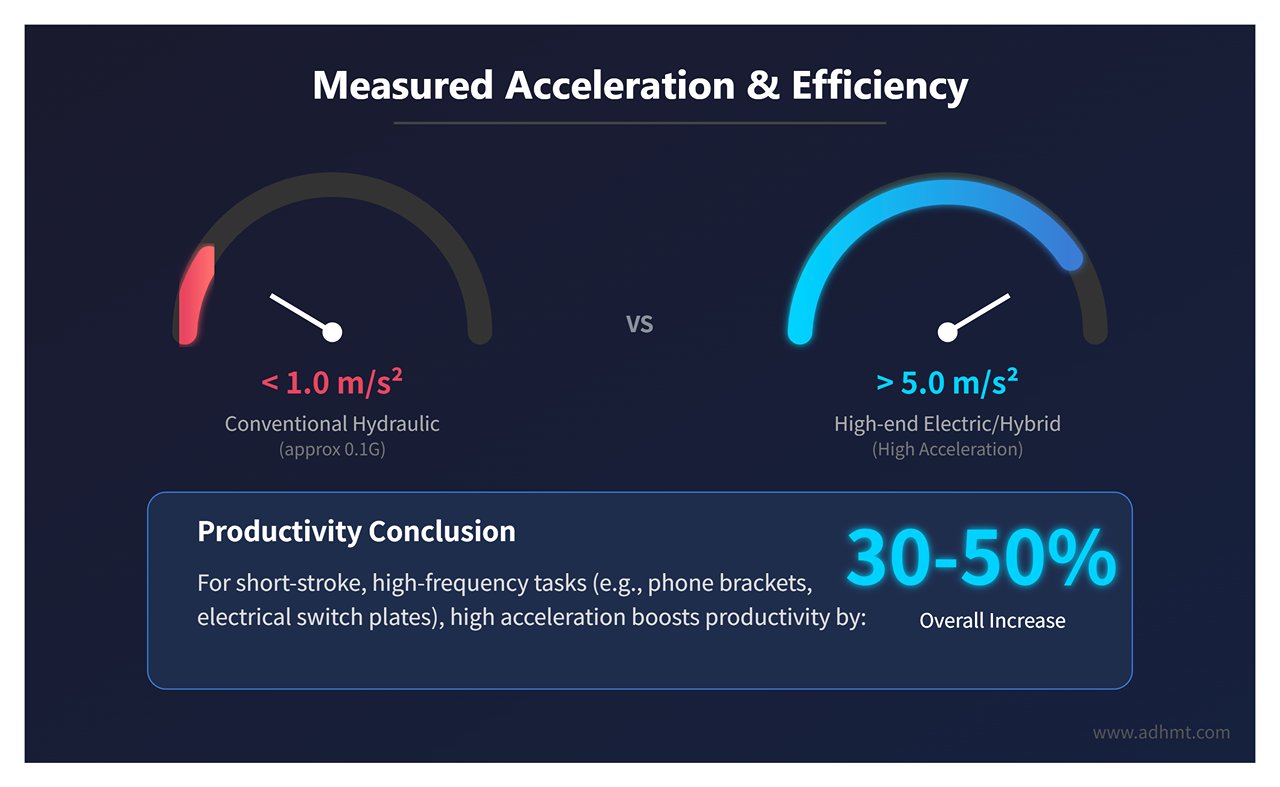
- Conventional hydraulic machines typically have ram acceleration of <1.0 m/s² (around 0.1G).
- High-end electric/hybrid models can reach >5.0 m/s² or even higher.
- Conclusion: When bending small parts like phone brackets or electrical switch plates (short stroke, high frequency), the high acceleration of electric press brakes boosts overall productivity by 30–50% compared to hydraulic machines.
- Hidden Time Cost: “Warm-Up”
- In winter workshops (ambient temperature below 10°C), hydraulic machines typically need 15–20 minutes of idle running to warm up the oil before reaching stable operation. This wastes both 20 minutes of productivity and unnecessary electricity. Electric press brakes, on the other hand, are completely “instant-on”—no warm-up, no waiting cost.
5.4 Tonnage Limits and Material Adaptability
There is no universal machine—only physical laws defining each technology’s domain.
- High-Tonnage Territory (>300T)
- This is the undisputed realm of hydraulic technology. To generate 500 tons of thrust with servo motors would require massive ball screws (whose cost grows exponentially with size) and extremely powerful motors. In contrast, hydraulics only need larger cylinders—cost scaling linearly with size.
- Processing recommendation: For thick plate bending above 12 mm or large shipbuilding components, hydraulic press brakes remain the only economical and reliable option.
- The “Sweet Spot” of Electric Technology
- <100T and <4mm sheet thickness—this is where electric press brakes truly shine. Within this range, their energy efficiency and speed advantages are magnified. If 80% of your factory’s orders involve stainless steel or aluminum sheets under 2 mm, sticking with hydraulics essentially means donating profits to the power company while tolerating lower productivity.
Ⅵ. The Hidden Iceberg: Total Cost of Ownership (TCO) and Deep ROI Analysis
This isn’t merely a technical choice—it’s a test of financial intelligence. Many factory owners focus only on the purchase price, overlooking the massive “iceberg” beneath the surface: operating costs that can reach two to three times the equipment’s original value over five years. To maximize profits, we must shift our thinking from “buying cheap” to “using smart.”
6.1 The Truth Behind Initial Capital Expenditure (CapEx)
When comparing quotes, it’s critical to understand the logic behind price differences.
- The ‘technology premium’ is real: Typically, an all-electric machine of the same tonnage costs 20–30% more than a hydraulic one. This markup isn’t inflated branding—it reflects the intrinsic cost of advanced components.
- Hydraulic components: Cylinders, pump stations, and valve sets are mature, standardized, and widely available industrial parts. Their supply chain is extensive, keeping costs under control.
- Electric components: High-torque servo motors and precision heavy-duty ball screws (or specialized composite belts) are cutting-edge parts produced by only a handful of global manufacturers (such as Rexroth, Siemens, NSK). The hardware itself carries a high intrinsic cost.
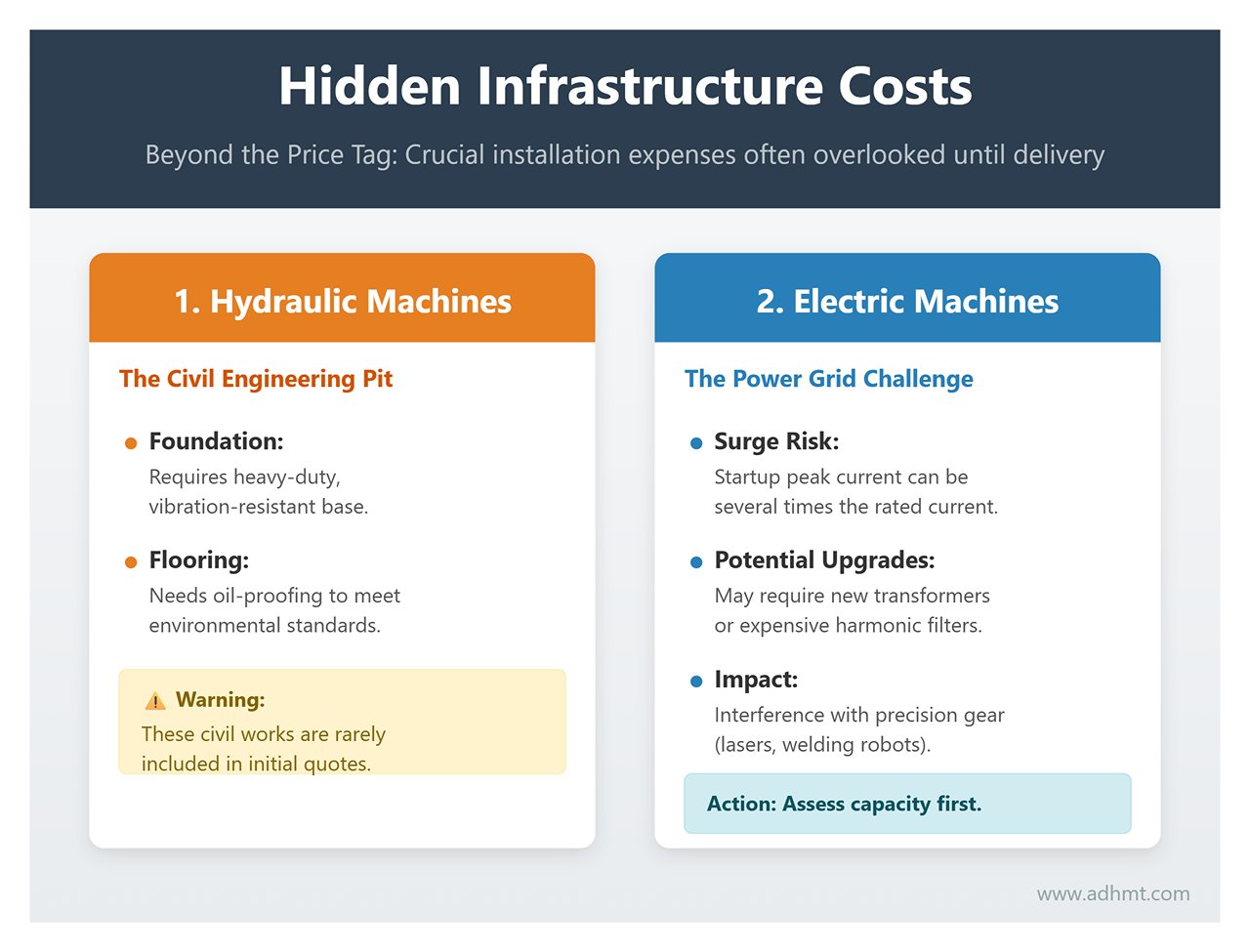
- Overlooked infrastructure expenses: Beyond the machine price, hidden installation costs often surface only when the equipment arrives.
- Hydraulic “civil engineering pit”: Heavy hydraulic machines may require a dedicated vibration-resistant foundation and oil-proof flooring to meet environmental standards. These civil works are rarely included in the initial equipment quote.
- Electric “power grid challenge”: Although electric press brakes consume less energy overall, their peak current draw during startup can be several times the rated current. This may force you to upgrade the factory transformer or install expensive harmonic filters to prevent interference with other precision equipment (such as laser cutters and welding robots). Always assess your workshop’s electrical capacity before purchase.
6.2 Five-Year Operating Expenditure (OpEx) Evolution
We use a five-year comparison window—the period when a machine is fully depreciated and delivering its core value. Over this time frame, the cost curves between hydraulic and electric systems reverse dramatically.
1. Energy Bills: From Power Hog to Efficiency Champion
- The energy sink of idle consumption:
- Hydraulic machines: Once the main power is on, the motor drives the pump continuously at around 1450 rpm, consuming 2–4 kW just to maintain pressure and cooling. Even while operators read blueprints or move sheets, the meter keeps spinning. Assuming four hours of idle time daily, this wastes 3,000–5,000 kWh annually.
- Electric/hybrid machines: Employ zero idle power consumption. The servo motors draw electricity only when the ram moves—no motion, no power.
- Dynamic energy consumption comparison: Based on extensive real-world data, electric or hybrid press brakes deliver overall energy savings of 50%–70% compared with traditional hydraulic models. For a typical 100-ton unit, the annual electricity cost difference alone can reach $2,000–$4,000 (roughly RMB 15,000–30,000). Over five years, the power savings alone could buy you a family car.
2. The Maintenance Cost Trap: The Curse of Hydraulic Oil
- The Hydraulic Nightmare:
- Oil Change Costs and Compliance Risks: Hydraulic oil (typically around 200 liters) must be replaced every 2,000–4,000 operating hours. Beyond the cost of new oil, the real burden lies in hazardous waste disposal. In regions with strict environmental regulations, the compliant disposal cost for a barrel of used hydraulic oil can exceed the oil’s purchase price.
- System Fragility: Filters, O-rings, and seals are high-frequency consumables. If a servo valve becomes clogged due to oil contamination, cleaning or replacement can cost several thousand dollars and requires a specialist on-site.
- Five-Year Cost Estimate: Maintenance and consumables typically total $5,000–$15,000, including labor and downtime losses.
- The Electric Minimalist Approach:
- Maintenance Requirements: Primarily refilling the automatic lubrication pump (at minimal cost) and periodically checking the belt or ballscrew tension.
- Five-Year Cost Estimate: Around $1,500–$3,000. Maintenance costs are just one-fifth—or even less—than those of a hydraulic press brake.
6.3 Hidden Gains and Opportunity Costs
Beyond the visible bills, several subtle factors directly influence a factory’s profit margin and long-term competitiveness.
- Lower Scrap Rate = Higher Profit:
- When working with high-value materials such as stainless steel, copper, or aerospace-grade aluminum, the electric press brake’s ability to achieve “first-piece accuracy”—thanks to zero thermal drift—is a major asset. Unlike hydraulics, which often require several test pieces each morning to “warm up,” an electric system can save you more in materials each year than on electricity.
- Downtime Risk:
- Hydraulic failures are often sudden and hard to diagnose—micro leaks or pressure instability can take hours or even days to resolve. Electric systems, built with modular architecture, typically fail at the electrical component level. Replacing a drive or motor can get production back online quickly. For factories operating under JIT (Just-In-Time) schedules, the unpredictability of hydraulics poses a serious contractual risk.
- Resale Value:
- After five years of use, electric press brakes generally retain 15–20% more value on the second-hand market than comparable hydraulic machines. Buyers prefer clean, oil-free equipment with stable accuracy and no need for major hydraulic overhauls.
Chapter Summary: If you only look at your bank balance today, a hydraulic press brake seems cheaper. But from a five-year operational perspective, the electric or hybrid model effectively pays for its own higher precision and faster speed through savings in energy, maintenance, and material waste.
Ⅶ. Scenario-Based Selection: Matching the Right Machine to Your Factory
Once we leave the controlled environment of the lab and step into the complexity of real-world workshops, the question of “which press brake is better” no longer has a single answer. The real challenge lies in aligning each machine’s technical strengths with your factory’s order composition, customer profile, and environmental constraints. There’s no absolute best—only the solution that maximizes your return on investment (ROI).
Below, we’ll strip away the spec sheets and explore three representative production scenarios to reveal the genuine logic behind machine selection.
7.1 When a Hydraulic Press Brake Is the Clear Choice: Heavy-Duty and Endurance-Focused Operations
If your factory operates in heavy industry and values rugged durability over sensitivity, the hydraulic press brake remains an undisputed powerhouse.
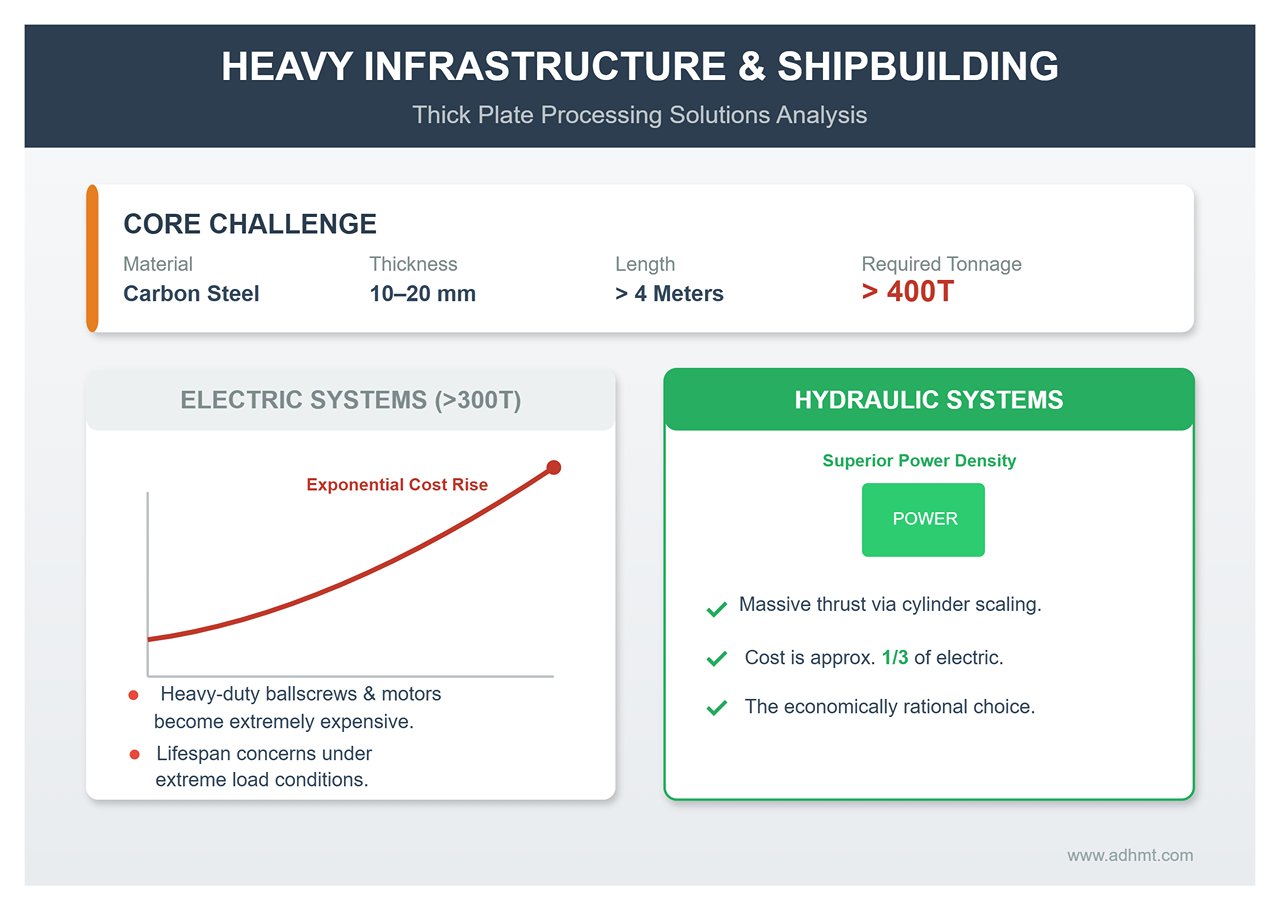
- Heavy Infrastructure and Shipbuilding (Thick Plate Processing)
- Core Challenge: These applications often involve carbon steel plates 10–20 mm thick and bending lengths exceeding 4 meters, requiring tonnage starting at 400T.
- Selection Logic: Beyond 300T, the cost of key electric components—heavy-duty ballscrews and servo motors—rises exponentially, and lifespan under such extreme loads becomes a concern. In contrast, hydraulics leverage their superior “power density,” achieving massive thrust simply by scaling up cylinder size, at roughly one-third the cost of an equivalent electric system. In this range, hydraulics remain the only economically rational choice.
- Environments Where Overload Protection Is Critical
- Built-In Safety Margin: When bending large steel structures, variations in plate thickness and operator error are inevitable. Hydraulic systems feature an intrinsic safety mechanism—the relief valve. It automatically releases pressure spikes to protect the machine. Electric presses, with their rigid mechanical connections, lack such tolerance; a sudden overload could snap a ballscrew or burn out a motor.
- Low-Usage Maintenance Workshops
- Cost Consideration: If the equipment is used only for in-house maintenance or occasional prototyping—less than two hours a day—the lower upfront cost (CapEx) of a hydraulic press brake is a major advantage. In such low-duty scenarios, its higher standby consumption is almost negligible.
7.2 When Upgrading to an Electric Press Brake Is a Must: Pursuing Ultimate Precision and Speed
If your customers inspect products with calipers—or even microscopes—or if your profits depend on fast-turnaround, high-volume small orders, an electric press brake isn’t just a tool; it’s your competitive edge.
- 3C Electronics, Precision Instruments, and Medical Devices
- Zero-Contamination Requirement: In medical, optical, or cleanroom environments, even the slightest hydraulic oil mist is unacceptable. A fully electric press brake, with sealed mechanical transmission and no hydraulic oil, is the only way to meet high cleanliness standards.
- Micron-Level Precision: For components like server chassis or smartphone parts, a cumulative deviation of ±0.01 mm can cause assembly failure. The direct closed-loop control of electric servos ensures that the first and the ten-thousandth piece are identical.
- High-Frequency, Multi-Batch Small-Part Production
- Acceleration Wins: For short-stroke (<20 mm), high-cycle parts such as electrical brackets, productivity depends less on top speed than on acceleration (Jerk). The electric press brake’s rapid start-stop capability enables the ram to operate like a sewing machine—achieving production rates typically 30%–50% faster than hydraulics.
- Operating in constrained environments and facing workforce challenges
- The Silence Advantage: If your factory is located near office buildings or you’re trying to attract younger operators, noise becomes a decisive factor. Electric press brakes operate at around 60dB—comparable to normal conversation—versus the 75–85dB of hydraulic machines, which sound more like a busy street. This difference significantly reduces operator fatigue and improves employee retention.
7.3 Strategic Trade-off: When to Consider a “Hybrid” System
This approach aims to combine the best traits of both systems, making it ideal for job shops handling diverse orders that require both flexibility and cost control.
- The Versatile ‘Do-It-All’ Processing Center
- Scenario: As a contract manufacturer, you never know if tomorrow’s order will be a 1mm precision stainless-steel enclosure or an 8mm heavy-duty equipment bracket.
- The Value of Hybrid Power: Hybrid systems—typically in the 80T–250T range—are top performers. They use servo motors to drive bi-directional pumps for on-demand oil supply: the pump stops when the ram is idle (saving power and reducing noise) and delivers full hydraulic force during bending. This eliminates the screw wear concerns of pure electric models at high tonnage while addressing the energy inefficiency and thermal drift issues of hydraulics.
- The Cost–Performance Sweet Spot
- A hybrid press brake typically costs 15–20% less than an electric model of the same tonnage, yet saves about 70% in energy and boosts efficiency by roughly 30% compared to a hydraulic machine. For most mid-sized sheet metal shops, it’s the ideal all-rounder—balancing today’s budget with tomorrow’s competitiveness.

💡 Expert Selection Advice in One Sentence
To make decision-making clearer, we’ve distilled complex analysis into three straightforward action rules:
- Making enclosures and precision parts? Go all in on electric. It’s a pricier investment upfront, but the savings in electricity, ultra-low scrap rates, and doubled productivity will pay for the difference within a year.
- Building structural steel or heavy machinery? Stick with hydraulic. Use the cost savings to invest in higher-quality tooling, CNC upgrades, or better overhead cranes.
- Running a job shop or contract manufacturing? Strongly consider hybrid. It lets you tackle precision jobs when needed and handle heavy plate when required—adaptability is the key to survival in a volatile market.
Ⅷ. Field Guide: Maintenance, Talent, and Workshop Management
Buying equipment is just the beginning of your investment; how you use it and who maintains it will define its real efficiency over the next decade. This chapter reveals the practical management insights beyond the manual, helping you squeeze every bit of profit through refined operations.
8.1 Fundamental Maintenance Differences: From “Oil Sludge” to “Clean Systems”
Maintaining these two machine types belongs to entirely different disciplines: fluid mechanics versus electrical engineering.
Hydraulic Maintenance: A Long Battle with Leaks and Temperature
The essence of hydraulic press brake maintenance lies in keeping the hydraulic system clean and stable—a skill often considered a “black art.”
- Temperature Redline Control: Hydraulic oil temperature must remain within 35°C–50°C. Once it exceeds 55°C, seal life drops exponentially, and thinner oil causes ram position drift. Practical tip: Install a dedicated oil cooler and include filter cleaning in your weekly maintenance schedule.
- The Art of Air Bleeding: After replacing any hydraulic component, air trapped in the system—even as little as 6%—can cause visible ram crawling or vibration. Full-stroke load cycling is required to purge air, and this demands an experienced technician.
- Detecting Invisible Leaks: Minor hydraulic seepage often goes unnoticed but accumulates over time. Use a UV leak detection lamp to inspect valve groups and fittings regularly. Remember, oil stains on the floor are not just waste—they’re safety hazards.
Electric Maintenance: Minimalism and the Battle Against Dust
Electric press brake maintenance resembles that of precision machine tools—or even a giant printer.
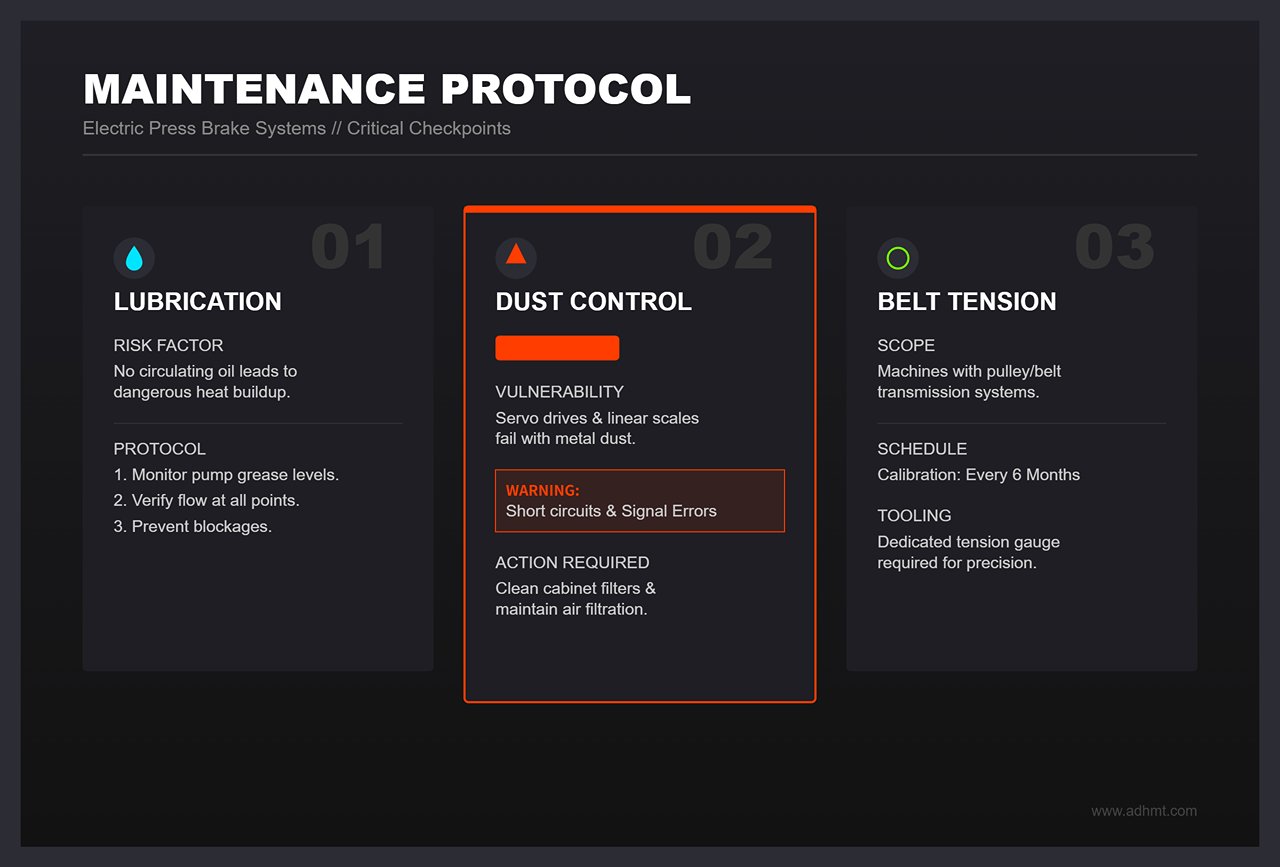
- Lubrication Is Life: With no circulating oil to dissipate heat, screw and guide lubrication is critical. Most modern machines have automatic lubrication pumps; the key action is to regularly check grease levels and confirm each lubrication point is dispensing properly (to prevent line blockage).
- Dust: The Greatest Enemy: Servo drives and linear scales are extremely sensitive to metal dust, which can cause short circuits or signal errors. Maintenance priority shifts from the machine’s internal components to electrical cabinet filter cleaning and workshop air filtration.
- Belt Tension Calibration: For models using pulley/belt transmissions (such as Safan-type machines), checking belt tension every six months is essential to maintain precision—this requires a dedicated tension gauge.
8.2 Workforce Transformation: The Ultimate Solution to Labor Shortages
Choosing your equipment is also choosing your people. Amid the industry’s widespread hiring challenges, different machine types attract and demand different kinds of talent.
Generational Skill Shift: From “Touch and Feel” to “Programming”
- Hydraulic Era – The Veteran Craftsman: Traditional hydraulic machines rely heavily on operator experience. When faced with bending angle deviations, seasoned operators instinctively use shims (like copper sheets) under the die to compensate for deflection—a hands-on technique that’s fading away.
- Electric Era – The Digital Native: Younger operators (born after 1995 or 2000) don’t need to understand hydraulic principles. They excel at offline programming—simulating bend sequences on a computer, generating code, transferring it to the machine, and executing it. This reduces dependence on individual skill and makes production highly standardized.
The Hidden Impact of Environment on Retention
- Noise Fatigue: Hydraulic machines produce constant pump noise (typically over 75dB) even in standby mode, draining both power and patience. Long exposure to low-frequency noise increases fatigue and turnover rates.
- The Quiet Advantage: Electric press brakes enable true “silent workshops” (0dB in standby, under 60dB during operation). Data shows that in clean, quiet electric workshops, young technicians’ retention rates are 20% higher than in traditional noisy, oil-smeared environments.
8.3 Quick Reference Chart for Common Faults
Every minute of downtime costs money. The following table offers a rapid diagnostic guide for both machine types:
| Fault Symptom | Hydraulic Press Brake Diagnostic Direction | Electric Press Brake Diagnostic Direction | Emergency Action (SOS) |
|---|---|---|---|
| Ram vibration/crawling | 🔴 Very common. Usually caused by air bubbles in the hydraulic oil, insufficient lubrication on guide rails, or incorrect back-pressure valve settings. | 🟢 Rare. Could indicate severe lead screw wear or a loose belt. | Hydraulic: Run the ram through a full stroke without load 10 times to vent air; Electric: Check lubrication pump oil supply immediately. |
| Angle instability | 🔴 Common (thermal drift). Large temperature differences between morning and evening or continuous operation causing oil temperature and viscosity changes. | 🟢 Extremely rare. Often due to uneven sheet thickness or inconsistent material properties. | Hydraulic: Preheat the machine for 15 minutes at the start of the shift or install air conditioning; Electric: Activate sheet thickness detection (if available). |
| System overheating alarm | 🔴 Common. Caused by dust buildup on cooling fans, low oil level, or a stuck overflow valve. | 🟡 Occasional. Caused by overheated braking resistor or clogged filters on electrical cabinet fans. | Hydraulic: Clean radiator and inspect cooling circuit; Electric: Clean intake filters on the electrical cabinet. |
| Abnormal noise | 🔴 High-pitched whine (pump cavitation), humming sound (bearing failure). | 🟡 Grinding noise (dry lead screw), clicking noise (damaged ball bearings). | Stop immediately! Hydraulic: Check oil level and filter; Electric: Manually grease mechanism and contact manufacturer. |
Chapter Summary: Practical Insights
If your workshop supervisor is the kind who can diagnose problems just by listening and has years of experience with hydraulic systems, a hydraulic press brake will suit them perfectly—easy maintenance and low costs. But if your operators are younger, prefer clean hands, and rely on screens rather than intuition, you should opt for an electric or hybrid model equipped with intelligent angle compensation and a graphical user interface.
In 2025, we’re not just buying machines—we’re buying management models. Choosing between using the machine’s intelligence (electric control algorithms) to cover human skill gaps or relying on human craftsmanship (hydraulic expertise) to compensate for mechanical limitations is a strategic decision you must make before placing the order.
Ⅸ. Buyer’s Guide: Avoiding Common Selection Pitfalls
Selecting equipment is like walking through a minefield— even seasoned factory managers often stumble over seemingly “safe” decision habits. Based on two decades of industry observation, many companies regret their equipment purchases within a year, not because of poor machine quality but due to blind spots in their initial selection logic. The following three fatal mistakes can easily cost you hundreds of thousands in lost profits over the next five years.
9.1 The “Tonnage Trap”: Bigger Isn’t Always Better
This is the most common—and costly—psychological trap. Many buyers think: “Most of our products only require 60 tons of force, but just to be safe, let’s get a 120-ton machine. Oversizing can’t hurt, and maybe we’ll land a big contract later.”
Such an “insurance mindset” is extremely dangerous in the press brake world:
- For Hydraulic Machines: It’s like using a heavy-duty truck for food delivery. Larger tonnage means a bigger cylinder diameter, requiring much more hydraulic oil per stroke. This results in higher energy consumption and longer cycle times. Your electricity bills could rise by 30%, while productivity drops by 20% due to increased oil-filling time.
- For Electric Machines: The penalty is even harsher. Large-tonnage motors have high rotational inertia, which significantly slows acceleration. You bought an electric press brake for speed, but oversizing kills that advantage. Moreover, heavy-duty ball screws for high-tonnage systems cost exponentially more—expenses that you’ll likely never recover from a few occasional heavy jobs.
🔑 Golden Rule: The 1.2× Factor — Calculate the tonnage required for 80% of your regular jobs, then multiply by 1.2 as a safety margin. For the remaining 20% of rare, heavy-duty orders, the smart move is to outsource rather than keeping a massive, underused “beast” idling in your workshop.
9.2 Ignoring “Auxiliary Time”: Bending Speed ≠ Productivity
Many technicians fixate on specs like “ram approach speed” and “bending speed,” assuming that a machine with a 200 mm/s approach speed must outperform one at 150 mm/s.
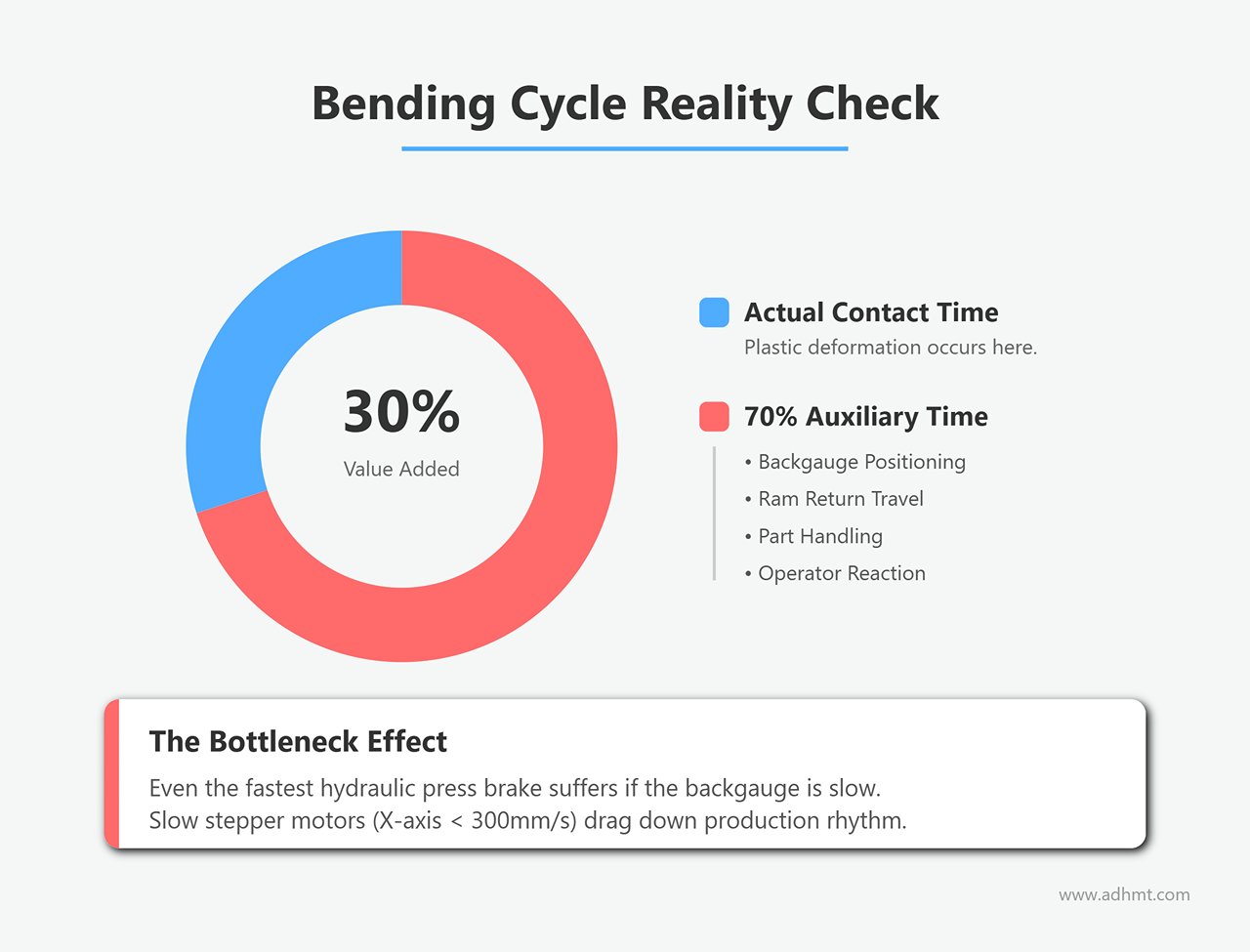
Reality check: During a full bending cycle, the ram’s actual contact with the sheet—where plastic deformation occurs—usually accounts for only 30% of total cycle time. The remaining 70% is “auxiliary time,” which includes backgauge positioning, ram return travel, part handling, and operator reaction time.
- The Bottleneck Effect: Even the fastest hydraulic press brake will suffer if its backgauge is driven by a slow stepper motor (X-axis speed <300 mm/s). The overall production rhythm will be dragged down.
- Electric Machines’ Hidden Advantage: High-end electric press brakes shine not only because of fast ram movement but also due to their six-axis servo backgauge systems (often X-axis >600 mm/s, sometimes up to 1000 mm/s). When processing multi-bend parts, the backgauge moves with piano-like precision in milliseconds—this is the true secret behind a 40% boost in overall productivity.
💡 Pro Tip: Don’t just ask sales reps “How fast does the ram move?” Instead, ask “For this 5-bend sample part, what’s the total floor-to-floor time per piece?”
9.3 Underestimating Environmental Factors: When Precision Meets Reality
“This machine achieved ±0.001 mm precision at the Hannover Expo—why can’t it do that in my workshop?” This is a classic buyer complaint. Many forget that top-tier equipment demands ideal environmental conditions.
- Voltage Fluctuation Risks: A servo electric press brake is essentially a giant computer-controlled system. If your industrial park has unstable power supply—voltage swings beyond ±10%—delicate servo drives may frequently trigger overvoltage or undervoltage alarms, or even burn costly control boards. If you choose electric, include a high-quality voltage stabilizer in your budget.
- Thermal Shock Costs:
- Hydraulic Machines: Sensitive to both cold and heat. Low oil temperature in winter causes starting difficulties; excessive oil temperature in summer leads to seal failures.
- Electric Motor: Even more vulnerable to “thermal shock.” The control chips inside the electrical cabinet and the high‑precision optical encoders are extremely sensitive to temperature changes. If your workshop reaches 40°C in summer without temperature control, not only will the lead screw expand and compromise accuracy, but the drive units may also frequently shut down due to overheating protection.
⚠️ Decision Alert: If your workshop is a semi‑open metal structure without a temperature‑control system and heavy dust exposure, investing in a high‑precision all‑electric press brake could be a costly mistake. In such conditions, a rugged hydraulic press or a hybrid model equipped with a powerful cabinet air‑conditioning system is a far more practical choice.
Ⅹ. FAQs
1. Which press brake type is more energy-efficient?
Electric press brakes are more energy-efficient because they consume power only during the bending process, unlike hydraulic press brakes, which require continuous power to maintain hydraulic pressure.
This on-demand power usage significantly reduces energy consumption, making electric press brakes both cost-effective and environmentally friendly over time.
2. What are the maintenance costs associated with hydraulic and electric press brakes?
Hydraulic press brakes have higher maintenance costs due to complex hydraulic systems needing regular fluid changes, filter replacements, and seal inspections, costing hundreds to thousands annually based on size and usage.
Electric press brakes have lower costs with simpler systems, avoiding regular oil changes or filter replacements, but may require specialized expertise for electrical components. Overall, electric press brakes offer more cost-effective maintenance.
3. What are the environmental impacts of hydraulic press brakes compared to electric ones?
Electric press brakes have a lower environmental impact than hydraulic ones. They are more energy-efficient, operating only during bending and shutting off when idle, reducing power consumption and emissions.
They eliminate hydraulic fluid leak risks and produce less noise. Overall, they offer a more sustainable option by minimizing energy use, emissions, noise, and environmental contamination.
Ⅺ. Conclusion
When deciding to select the right press brake on the market, please consider your business needs, production capacity, and energy efficiency goals. If you use thicker materials that require higher tonnage or precise control of the bending process, a hydraulic press brake may be a better choice.
On the other hand, if you prefer machines with low energy consumption, high automation, and low noise, an electrical press brake may be a better choice.
Compared to electric press brakes, hydraulic press brakes often have a higher initial cost. However, in the long run, well-maintained hydraulic press brakes can save money because they have a longer lifespan.
We are a manufacturer of professional press brakes, laser cutting machines, shearing machines, and other machines with a history of 20 years. If you are interested in purchasing a press brake now, you can browse our official website or contact us. Our experts can help you select the right Electric Press Brake or CNC Press Brake model suited to your production needs.













 English
  العربية
  বাংলা
বাংলা  Български
  Čeština
  Dansk
Dansk  Nederlands
  Deutsch
  Suomi
Suomi  Français
  Ελληνικά
  עִבְרִית
  हिन्दी
  Magyar
  Bahasa Indonesia
  Italiano
  日本語
日本語  Қазақ тілі
  한국어
한국어  Bahasa Melayu
  Norsk bokmål
  فارسی
فارسی  Polski
  Português
  Português do Brasil
  Română
  Русский
  Српски језик
  Slovenčina
  Español de México
  Español
  Svenska
  Kiswahili
  தமிழ்
தமிழ்  Türkçe
  ไทย
ไทย  Tagalog
  Українська
  Tiếng Việt
  اردو
اردو  简体中文
简体中文  香港中文
香港中文  繁體中文
繁體中文